After Care

I want to share with interested readers the article below “Do You Know?”, which I wrote in 1993, mainly due to the frustrations I experienced when I cared for my husband Clive. Clive suffered his life-threatening stroke at age 50, on 21 September 1991. His legacies were many; the physical legacies were obvious, but it was the hidden legacies, Clive’s ‘ugly beasts’, that were of major concern:
aphasia/dysphasia: dyspraxia: hemianopia: epilepsy: depression: hemiplegia: perseveration: thalamic pain syndrome: venous incompetence: anosmia/ageusia
After Clive was discharged from the rehabilitation centre, he was offered follow-up rehabilitation at a day centre. When he first started attending the day centre, I found it difficult to look beyond the present and was under the impression that most of his gains wold be made within the first 18 months’ post-stroke; which was the frame I had in mind for his time at the centre. This proved to be a misconception on my part. His time at the centre was short-term, goal-orientated and time framed. The dilemma for Clive and me, and for many people in our situation, was fear of the unknown; fear of what the future may or may not hold. At the time of Clive’s stroke there was little information as to where to go next after discharge from rehabilitation and/or day centre. As a result, we were constantly struggling with our fears and insecurities ‘what will happen to us and where do we go?’ – what I call the ‘grey area’.
As I was a working person, I found myself constantly searching the internet to see what was available for us and was shocked at the widening gap (more like a chasm), which Clive was continually slipping through – he wasn’t old: he was just 50!
Clive and I were among the 150 people who attended the Open Forum on Strokes which took place in Adelaide, on June 28 1992. The focus of the forum was to outline the lack of services and cutbacks in funding for existing services, resulting in closures of some vital facilities that were a lifeline for people trying to get back on the path to recovery. The key speakers were very frank about the deficiencies in the system and the lack of desperately needed services. To initiate change would require a combined effort: in other words, we needed to stand up and be counted!
From this meeting, regional support groups were formed. Our support group coordinator, linked Clive into Take Five (a respite agency): he was entitled to a care worker for four hours per week. One of the members from the support group resourced and found information for those who were afflicted with aphasia; we learned of a talk back group founded in 1995 by speech pathologist Deborah Hersh - Clive had both receptive and expressive aphasia and became a foundation member of the group: the momentum was gathering! As the years progressed, Clive became the proud owner of a mobility scooter. Everything combined started to break down the isolation forced upon him as a result of his stroke: life was improving!
Through my concerns regarding the lack of services and centres; out of sheer frustration and determination to survive, I dug my heels in and became Clive’s case manager. I set in place a very good network for Clive’s home program, consisting of private professionals, my two girls (Penelope and Sarah) and me, plus a few loyal friends. I couldn’t rely on a system that in some areas was failing those in need.
Many readers may think Clive and I had tunnel vision, which might have prevented us from recognising and appreciating what we had already received and benefited from in the way of services. Clive and I fully realised that we were privileged to live in Australia – without doubt the land of plenty. We have never taken for granted anything that came our way, but felt that this wonderful country of ours was capable of giving much more.
I believe that people in power who make decisions on behalf of people like Clive and carers like me, should learn first-hand what it is like to ‘walk in our shoes’. I’m sure this would give them a better understanding, which could help accelerate the process of bringing about changes that are so sorely needed.
I often wonder how funding is allocated to the organisations in desperate need – I visualise a chess board, the organisations are like pawns in the game of chess; take from one to give to the other. Check mate! WELCOME TO THE WORLD OF DISABILITY!
For people living in Adelaide, South Australia, the following groups may be of some benefit:
- Talkback Association for Aphasia Inc. aphasia.asn.au
- Stroke SA Inc. stroke.org.au
- Carers SA carers-sa.asn.au
- Take Five Respite Agency unitingcommunities.org.au
###
DO YOU KNOW?
Have you ever wondered what happens to a young person who has become the victim of a stroke? I mean a stroke so severe that it withdraws that person from the workforce before their retiring age?
Can you ever begin to imagine what it would be like? One day everything is running along at its normal pace and life is fine, excellent job etc., then the next day life almost comes to a halt. The brain, which is the control panel of the body goes on strike, malfunctions, and the work stations in the body start to shut down: some sections permanently. But during this period there is a sorting process at the control panel, where it is decided what sections will resume duties and in what capacity.
The stroke victim is in intensive care, the doctors and staff put all their expertise into action, and the victim starts to drift from the world of unreality into reality. The damage report is given and the full extent of the horror of that stroke sets in, and it is devastating! Life goes into slow motion.
THEN WHAT? Well, an assessment will take place to see if the person can be rehabilitated, that is if luck is on their side. Depending on the areas and extent of the damage, there will be two choices: (a) rehabilitation centre or (b) nursing home.
If you have been chosen for (a), you will be transferred to a rehabilitation centre where the hard work really begins. The training is carried out by an excellent team of care nurses, doctors, physiotherapists, occupational therapists and speech pathologists. The re-training is hard slogging for all concerned. The length of stay at the rehabilitation centre will depend on the progress gained. According to progress, the choice will be either (a) discharge home or (b) discharge to a nursing home. If you are lucky to be able to choose (a) there may be follow up therapy offered from a day centre. The centres are run by the most caring of staff, but bearing in mind this service will be offered on a short-term basis only, depending on progress made, then once again services will cease. If you have access to this service, you are the fortunate ones.
THEN WHAT? Well, once all the initial ground work is done, the medical team have done their job; the rehabilitation team have done their job; the person has, to the best of his/her ability done their job, working hard with what services have been offered. Friends and visitors drift in and out doing their job by keeping the morale high and stimulated. The person then starts to wonder what life has to offer. It is all too often one hears the negative comments ‘Did you hear about poor Joe? Poor devil, only a young bloke – had a stroke, well it’s the end of the road for him!’
BUT IS IT? It is all too easy to categorise people and put them in the ‘too hard basket’, and then grade them according to statistics and types of strokes. Every stroke is different and everyone’s expectations of life’s goals, dreams and aspirations are different. Why be placed on a scrap heap, when a person knows in their own mind that more can be done if given some sort of chance?
WHAT ELSE CAN BE DONE? Well, there is private therapy, if your income allows for that sort of luxury. This luxury can only continue for us as long as an income still flows in, and of course there is a yearly limit on how much one can claim from private health cover, then it is 100% out of the pocket. This then governs how much you personally can offer the person to achieve some of his/her goals, shattered dreams and aspirations.
WHAT ABOUT HELP? Yes, what about it? There are very few facilities, if any, available which solely cater for a younger age bracket. Strokes do not only affect the aged population of our society. Very young people have strokes, and it is this younger sector which is not catered for.
WHAT ABOUT GOVERNMENT ASSISTANCE? Well, what about it?
Source: © Carol Rosemary Fuller. Stroke SA Newsletter Nov.1993.’Do You Know?” Page.5.
Carol Rosemary Fuller
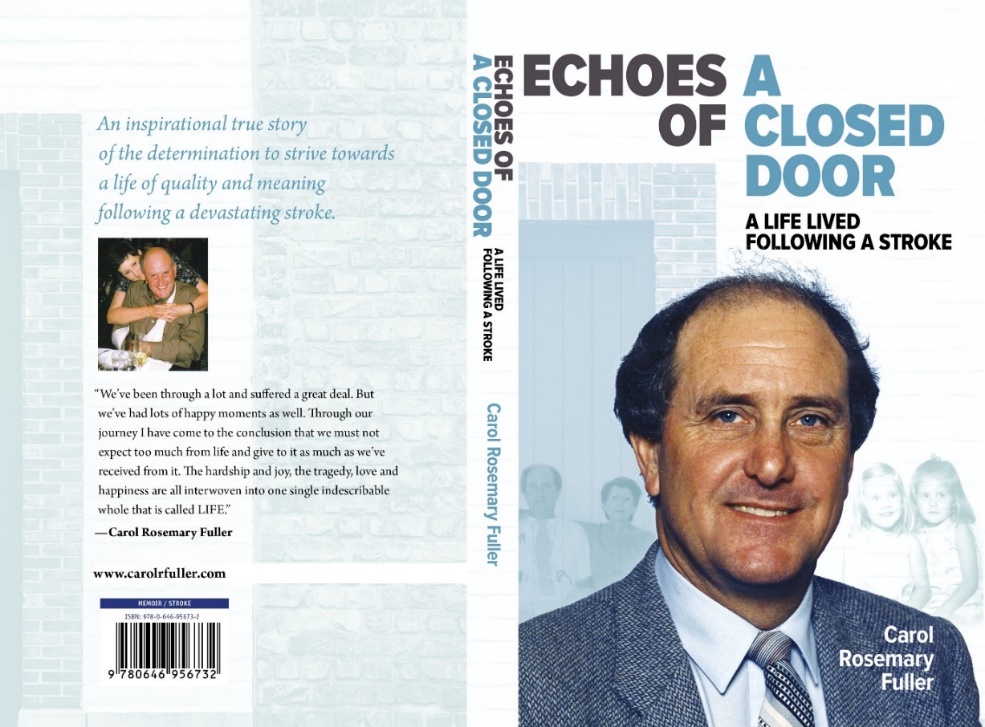
Author: Echoes of a Closed Door – A life lived following a stroke