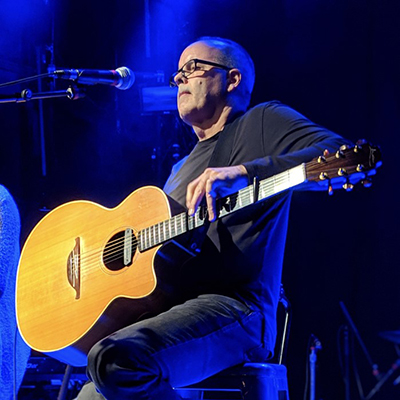
Ken McCaw: playing guitar one handed

Ken was 47 when he had a stroke.
He woke up feeling lousy so made a call to cancel work and went back to sleep. When he woke up at midday, he could no longer move his right side and recognised that his speech was slurred.
He called the ambulance immediately.
The paramedics arrived within minutes. Ken was taken to the nearest stroke centre, and was promptly assessed and treated with a clot-busting drug (tPA).
One of Ken’s goals after his stroke was to get back to playing guitar. Ken has shared a bit about his journey below:
What year did you suffer your stroke?
I experienced my stroke in November 2011. I use the word “experienced” intentionally. To me the word “suffered” sounds too negative and victim-like. And if I said “had” a stroke, that feels too light and doesn’t convey the magnitude of what happened. I believe that the words we use are important. So, for me, my stroke experience started on that day and continues to the present.
What deficits and challenges do you have since your stroke?
To this day I cannot extended my right arm or open my right hand. As well, my right leg requires a FES device (Walkaide) to address drop foot.
How long have you played guitar?
I have played guitar since my early teens, so a little over 40 years. My mother played guitar, along with several other instruments, so there was always music around our home. And an instrument to borrow.
When did you pick up a guitar after your stroke?
While in outpatient rehab, after a 2 1/2-month hospital stay, my OT Tanya asked me if I had considered some kind of one-handed guitar technique. Neither of us knew exactly what that would look like, but a seed was planted that was encouraging. Rather than wait for some “maybe” of improvement in my right hand, one-handed guitar playing was something I could start investigating right then.
How did it feel picking up your guitar again?
I couldn’t imagine becoming an ex-musician, but I had other urgent priorities like being able to walk again. And all the other tasks that are part of regaining independence. Those came first. Eventually I started experimenting a bit with one of my bass guitars. I didn’t have the strength to support the weight hanging around my neck, and I couldn’t balance it in a sitting position. So, I purchased a stand that would allow me to walk up to the instrument, play a little, then walk away without risking damage to it or me! But it was a promising start.
Describe the journey from your stroke to where you are today in relation to playing the guitar.
Early 2012: OT Tanya planting the seed of possibility-one handed guitar playing might be possible.
Spring 2012: I reached out to Bill Clements, a one-armed amputee who is an amazing bass player and a wonderful person. His encouragement got me started.
Summer 2012: I saw English guitarist Jon Gomm at a venue near my home in Toronto. His unbelievable two-handed style of percussive, melodic inventive playing really got me thinking. If I could do just a fraction of what ONE of his hands was doing, I’d be thrilled. I realized right then that I was going to do it.
Easter 2013: First time back on-stage playing bass with the band in front of several hundred people at my church. An unforgettable moment.
Autumn 2014: I was invited to be the opening speaker at the Stroke Collaborative Conference in Toronto. My first real conference, my first public performance on solo acoustic guitar. I knew this was my calling.
Fall 2017: I released my debut album - On The Other Hand. A collection of five original compositions for solo acoustic guitar.
Fall 2019 - I was approached to contribute my story to a book entitled The Awesome Music Project, a fundraiser supporting research into the mental health benefits of music. The book comes out on October 10, World Mental Health Day.
What advice do you have for other guitar players with mobility issues? What advice do you have for people to wish to play an instrument after their stroke?
Make no assumptions about HOW it should be done. My only goal was to make music with my guitar. Music that was good enough, so that I wouldn’t hear “oh that’s really good, considering you’ve had a stroke”. I tune my guitar differently, I strike the strings differently, I wear my guitar differently. The most important lesson I’ve learned is that it doesn’t need to be done the way I used to do it. And that applies to almost everything now, not just music. After all, playing guitar with two hands is for beginners!
What do you consider your greatest achievement since you stroke?
The greatest achievement post stroke was becoming a conference keynote speaker. The idea of converting a relatively negative experience into something of real value for myself and others. That’s pretty cool.
 've designed one specially to overcome the problem. Sorry, this is an awful program to handle and I couldnt find the pix I wanted...my address deigh123@gmail.com please E-mail me