New Year's Resolutions - Goal Setting

With the old year fast fading into the background and the New Year starting to rapidly slip by, I am wondering how many people made a New Year’s Resolution or mapped out their goals for 2017. It is very easy to think and say ‘I’m going to do this’ or ‘I’m going to achieve that,’ but sometimes the goal we had in our mind and wanted for ourselves may be unrealistic or unattainable - far too difficult to physically achieve.
When my husband Clive aged 50 suffered his near fatal stroke in 1991, I made the decision to live in with him for the duration of his stay in hospital. During the long hours of the night, under the cloak of darkness, I would slip my hand through the rails of the side guard on Clive’s bed and hold his hand; it was our private times. Even though he was still in a semi-conscious state, his fingers would struggle down my left hand, feel for my wedding and engagement rings, and then squeeze my hand. I was at this stage his umbilical cord - his link to life. It was during our private times that I would tell him how much he was loved; how much the girls and I wanted him to make the incredible effort to return to us and again be a part of our family.
When Clive regained consciousness and the medical team made their rounds, he was told of the legacies of his stroke; he lay still, listening and trying to comprehend what he had been told. He was unable to express his grief, disbelief and despair in any other way than to sob. This was not what he wanted to be. He was determined to better himself.
I was still sleeping by his side; during the early hours of the morning I was aware of movement in his bed. With his left-hand he gripped the rail on the side of the bed in an attempt to pull himself into a sitting position. He tried to reposition his left leg, and to turn over on to his side. He was testing himself, assessing what he had been left with and what the stroke had cruelly robbed him of. He was determined, even at this early stage, to put his blueprint plan into place. Clive was a perfectionist; it was his nature to problem solve – he was determined to set goals to enable him to move forward with his life. But realistically, although Clive was unaware, the first goal he set himself and achieved was to actually survive the stroke.
Although it was questionable that Clive would be able to be rehabilitated, he underwent an intense rehabilitation program, worked extremely hard trying to relearn and regain some of his losses. Exhausting as it was, he made progress and was able to return to his own home. Our 89-day journey of hospitalisation and rehabilitation had been long and hard, but we had grown strong together. We were both so determined.
Just because he was in his own home, the hard work didn’t stop there. I was determined not to wrap Clive in cotton wool, he was an independent person prior to his stroke, therefore it was important to make him realise that he could also be an independent person after his stroke. He was an intelligent adult and needed to be treated as such. He had to maintain a positive mindset.
Clive was accepted into the day centre to reinforce what he had been taught at the rehabilitation centre. It was at the initial meeting when he was asked about his goals. It was fortunate we had discussed goals before we attended the meeting: Clive indicated he wanted to return to work. When Clive was asked about his goal, I answered on his behalf with Clive nodding his approval – he wanted to return to work. My comment was met with a disapproving silence, followed by words to the effect: ‘This is an unrealistic goal. It’s not going to happen’. I held Clive’s hand and, and in front of the interviewer, assured him that I would support him in any way possible to achieve his goal, the goal he set himself. We felt crushed. Clive continued with therapy reaping goals: independency in a wheel chair; walking with a quad and eventually discharged walking with a walking stick. These were significant goals – goals achieved under such extreme conditions. Although at this stage Clive’s aphasia was still frustrating, we were able to get by using charades and his incredible method of ‘stick drawings’.
Because of Clive’s immense loss, in 1993 I approached the University of Adelaide; Electrical Electronic Engineering Department (Clive’s former employer) to ask whether Clive could attend his former department, mingle with colleagues and perhaps perform some small task to help alleviate the isolation his stroke forced upon him. There were legal implications to consider and with a lot of background work, a work therapy program was drawn up and signed by all parties associated with the responsibility of overseeing the legality and safety of Clive’s program. Clive attended the university on Friday morning for four hours; the program ceased in 2004. With the attendance at the work therapy program and his deteriorating health condition made Clive realise that the goal he set himself to return to work was unachievable; but realistically the work therapy program temporarily filled the gap and helped ease the transition from the working life he had once known and enjoyed, to a quality life as a retired employee. As long as he could maintain contact with the university in some capacity, he was satisfied. This was the issue I tried to point out the day Clive attended his interview at the day centre; it was necessary, I said, for Clive to have the chance to reach that decision himself. By doing so, he would never have to doubt himself, which, in those early days, could have been detrimental to the outcome of his future. He was now sure in his own mind.
Clive continued to goal set over the years. He attempted many tasks around the house and garden; he attended gym to keep himself fit and well to enable him to succeed in the tasks he felt so passionate about. His forward thinking and determination brought to fruition a passionate goal he set himself – to travel overseas for his 60th birthday – this he achieved and travelled overseas between 2001 and 2011 a total of six times.
Goals can be a wonderful incentive if carefully thought through and made achievable. To set goals that are unachievable will only culminate in disappointment through failure of achievement. Goals are life’s stepping-stones to create a quality life; although perhaps not the life we really want, but a different life we can embrace.
|
|
Clive – Working in the garden |
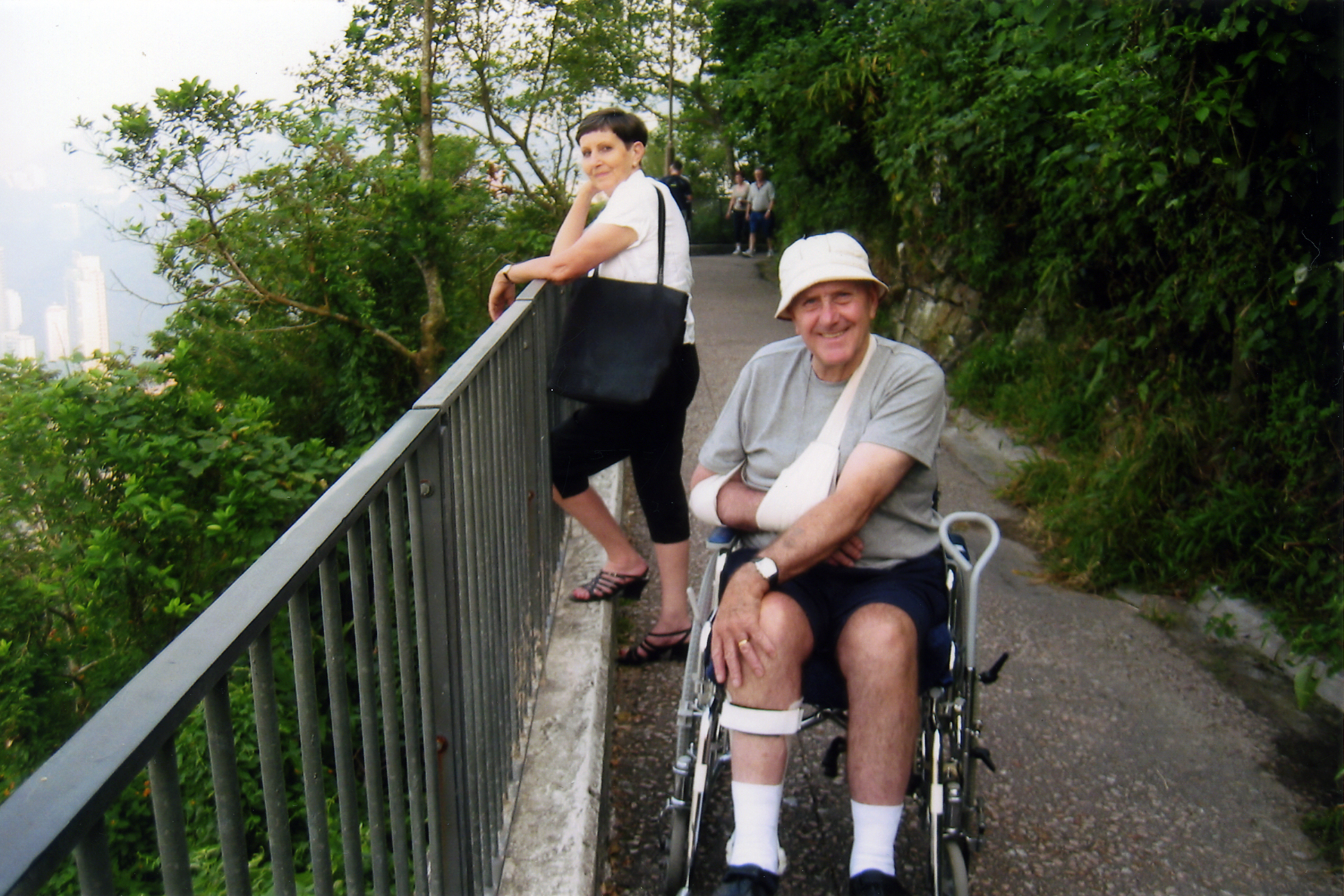 Clive – Victoria Peak Hong Kong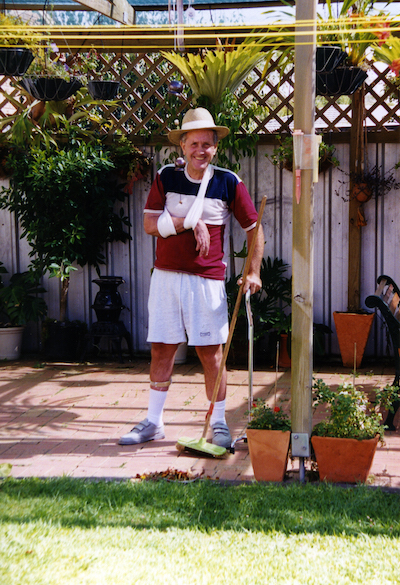
I would like to take this opportunity to wish everyone health, happiness and the best of luck for goal setting in 2017.
© Carol Rosemary Fuller
Author: Echoes Of A Closed Door - A life lived following a stroke
