Toni Arfaras and i-Rebound

When you get involved in research, you contribute to improving knowledge about stroke, stroke treatment and recovery.
Getting involved in research may allow you to get access to emerging therapy you wouldn’t otherwise have opportunity to use and may form part of your recovery plan.
Toni Arfaras has used research broadly to contribute to her recovery goals. In this interview we talk to Toni about the most recent research project that she volunteered for, called i-REBOUND After Stroke.
About i-Rebound, now
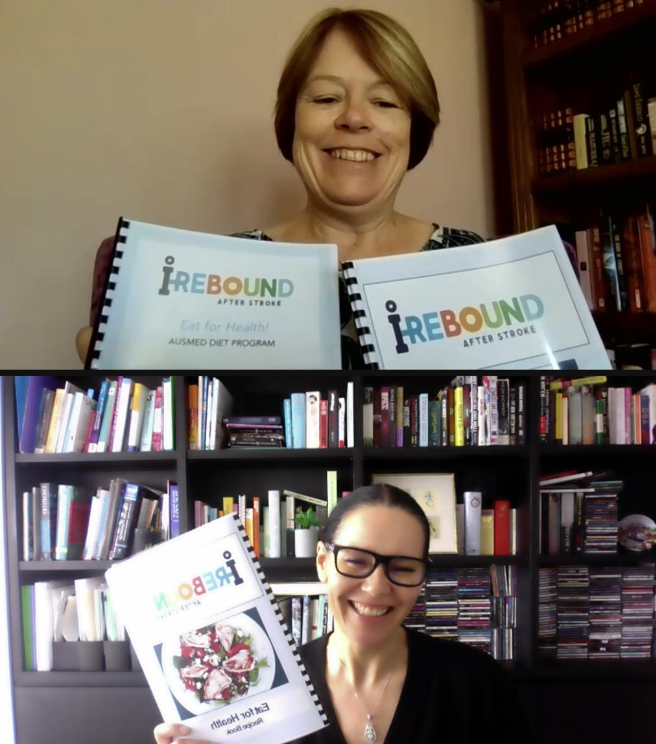
University of Newcastle’s Professor Coralie English is currently leading this study that is using telehealth to deliver the i-Rebound “Lets get moving” and “Eat well for health” programs. These aim to prevent recurrent stroke and support long-term health and well-being. People from all over Australia can take part and have access to supervised exercise and dietary advice in their own home, seeing the health professionals over telephone and videocalls. The programs have been designed for, and with the input of, people who have had a stroke. There’s support for people who don’t have experience in using technology before.
Coralie says, “After a stroke, getting enough exercise and eating a healthy diet are important to live well and to reduce the risk of having another stroke. Currently, there are no online exercise and healthy eating programs designed specifically for people with stroke.
i-Rebound – what’s next?
‘Team English’ has now secured more funding from The Stroke Foundation to develop the program further into an all-online resource that stroke survivors would be able to access anytime - when and where it suits them.
The “i-REBOUND” online resource will be designed in partnership with survivors of stroke to make sure it is accessible for all, including people with aphasia. The website will include resources like exercise videos, menus and cooking demonstrations, featuring people with stroke. It will be housed on Stroke Foundation’s EnableMe resource and online community.”
Want to work with researchers on developing i-REBOUND online? Read more here.
Thank you, Toni, for sharing your experience with research and the i-Rebound telehealth project.
1. Why do you join research projects?
When I joined my first research project, I saw it as an opportunity to educate myself and improve my outcomes. The first research project that I joined had a focus on improving fatigue after stroke and given how much I was impacted by this I felt it had my name on it.
Since then, I’ve put my hand up for a few different projects. While most have had an element of me being able to see a potential benefit to myself, I really like the idea of knowing that what I’m doing could help inform future practices and therefore contribute to improving life for someone else post stroke.
2. Why did you join i-REBOUND?
Like most people, I know what healthy eating should look like. I also know I should exercise more and lose weight, but these are things that have proven more difficult post stroke. Knowing this project could be addressing these topics whilst utilising videoconferencing really appealed to me. There is a diet and exercise group that I was really hoping to get into but it’s a randomised allocation and I ended up in the diet group.
3. Describe a few things that stick in your mind about the experience.
The support and encouragement of Karly has been instrumental in making my experience so enjoyable. The diet is hoping to reduce people’s cholesterol and blood pressure but because both of these are fine for me my personal aim was to lose weight. The one-on-one sessions have been so beneficial as Karly personalised the diet approach so that it suited me.
4. What has had the greatest impact on you? And has it helped other people in your family?
Prior to my stroke I was a confident cook, but I have had so many mishaps with wrong ingredients and not correctly following recipes. Since taking part I’ve become more adventurous in throwing things together (not always successfully).
My husband Nick has become a lot more aware of what he eats, and in the process has lost around six kilos. He is amazed that he doesn’t feel hungry anymore.
We both have taken on what I’ve learned and look at it as having gained lifelong healthy eating habits.
5. What would you say to someone who is thinking about joining?
Do it! Taking part in this research wasn’t arduous. I only had to tweak a few things I did, and those changes have had beneficial impacts for the whole family.
The ENAbLE-pilot trial (incorporating the i-Rebound programs) is open to people who have had a stroke or TIA and would like to take part in the study via telehealth.
Read more on the study webpage
Contact Margy on (02) 4042 0999 or email enable-pilot@newcastle.edu.au
Join the Stroke Research Register (Hunter)
If you’ve had a stroke or a transient ischaemic attack (TIA) and want to find out more about other research studies, join us! Members receive personal invitations to take part in research, and can test new ways to prevent strokes and new treatments and therapies for recovery.
Chat to Gillian Mason, the Register Manager, on (02) 4042 0093, email strokeregister@hmri.org.au or become a member online in 5min, at https://hmri.org.au/stroke-register