From Karen: My long term experience with sensory impacts

Sensory impacts of stroke. One person’s experience. Longer term…
As time passed after my stroke and I was able to walk a few blocks from home to a playground with my two children. I needed to hold their hands near roads and the child on my affected side would often tell me that I was squeezing their hand so hard it hurt. I’d loosen my grip a little and think I still had a firm grip on their hand. I'd be surprised when they would wave both hands in the air and I’d realise that my hand was gripping nothing. I couldn’t distinguish whether I was holding their hand or if my hand was empty.
Then my neurologist told me that I was ready to return to work. I didn’t feel anywhere near ready! Since my stroke, all food had tasted bad, it was a side effect of my medication, but my doctor and I hadn’t worked that out yet. I walked into my workplace 15kg thinner and everyone told me how ‘great’ I looked. I felt the opposite of ‘great’.
Going back to work I’d catch a crowded train and it was all I could do to maintain my balance standing on a moving train. I wanted to sit down on a ‘disabled’ priority seat but didn’t have the resilience to discuss my need for the seat with people focussing on their phones with headphones in. The whole journey I wanted to scream at the people around me because my brain was stressing that someone’s bag might brush against me. It’s called tactile defensiveness.
I walked into my workplace and my closest workmate came over and asked me what projects I was working on. I’d been off work for six months and had been back in the office for ten minutes. I was working on being able to spend two hours per week in an office with 15-minute breaks every half an hour. Another colleague happily told me that I didn’t look like I’d had a stroke. I was seated and stationary, I snapped and told her that not all impacts of stroke are visible because it’s a brain injury and my brain is on the inside of my body.
Later I felt bad as I felt it was her self-talk saying ‘I feel better knowing that if I had a stroke that people might not know it to look at me.’ I understand that stroke in people of working age is confronting but I was confronted and struggling to deal with my own emotions. If you ask me what’s the ‘right’ thing to say to someone who returns to work after a long absence due to illness? I would say ‘It’s great to see you.’
More time passed, I got my driver’s license back and my children started school. I wanted to get to know other parents so my children would be invited to birthday parties and to friends’ houses to play, but I was struggling to get through the day. And ten minutes in a schoolyard had me shouting hysterically at my children from the time we got into the car until they finally fell asleep. I realised that I couldn't do pick up in the schoolyard, so my children missed out on playing on the playground with friends and I felt like an outsider and judged. I recognised I was a high achieving parent but I was not able to live up to my own expectations. Some people in my life thought it would be helpful to let me know where I was failing! I could see that for myself and I was running an uphill marathon every day, absolutely giving 110%. I started a blog to share information about the impact of my stroke on my parenting and my children in the hope that people would understand. More about that here…
Along the way my husband and I separated. Stroke puts an incredible amount of pressure on a marriage and if there are any underlying cracks things start to unravel. I met a new partner and life was good again. Only every intimate, nurturing touch on my affected side made me want to leap out of my skin and headbutt them. He joked that I was the only person he’d ever met who needs to an accompanying instruction manual.
My therapists told me to pace myself and get plenty of rest, but there was only me. I felt I had no option but to work and parent until I dropped. There’s not much middle ground in stroke recovery, either you’re largely dependent on others and eligible for a small amount of government assistance, or you’re rehabilitating to high-functioning independence. The assumption is that if you can walk and dress, that you can do everything simultaneously. I can do everything I want to and need to do, but I can’t do everything on the same day or in the same week. I would (and still do) crash at least once per month and am bedridden in silence for two to three days at a time, taking even more sick leave from work and was reliant on friends and neighbours to bring us food. Thank goodness for Facebook and friends who respond to distress calls. However, I was worried that I would lose my job because of how often I was absent and my reduced capacity when I was there.
Time went on and I received therapy to retrain my sense of touch and adapted to my deficits – a bit about that here…
I was medicated for my post-stroke pain to take the edge off it so at least I was functional, I’d worked out strategies to be able to concentrate in most essential situations, but I had what feels a bit like whole body narcolepsy many times every day and had no idea what was going on. Throughout my stroke recovery I have devoted a significant amount of my time to stroke research and in desperation, I asked the top stroke brains I knew for recommendations of specialists who might be able to help me understand what was going on. Many medical appointments and many hundreds of dollars later, I finally got some answers. I was managing sensory overload/sensory overstimulation. I kid you not, it took me four years and the best specialists I could find to work out what on earth was going on for me. The best explanation I got was that our brain takes in lots of information in many ways, from all around us and works out what to pay attention to and what to let pass on by. My brain doesn’t filter. It pays attention to absolutely everything until it is so ‘full’ it literally shuts down. Like a safety switch in a fuse box. I find it difficult to explain what sensory overstimulation feels like, but it’s the kind of feeling that makes you want to put your head through a brick wall to make it stop. Sensory overload is most common in children with Autism Spectrum Disorders. This video is a very accurate portrayal of what it feels like for me. It’s all I can do to watch this video and not curl up in a ball to block out the sensations.
Finally, I consulted a neurologist, searching for a magic pill that would turn off the insane heightened experience of sound, light, and movement. She told me that any medication would dull my whole brain function and the only solution was to ‘do less’. I wrestled with this advice for a long time and worked through a lot of ‘I can’t’ self-talk. It took me a good few years, but ultimately I took a step back in my career and learned to distinguish the ‘absolutely essential’ from the ‘very highly desirable’.
Over the past few years, I’ve found out that sensory overstimulation is very common amongst stroke survivors, especially those with touch sensation and prorporioception deficits and also common amongst people with other neurological conditions like MS, epilepsy and chronic fatigue syndrome. But there is very little literature about it and in my experience, it’s not talked about by most medical and allied health professionals in the stroke field. For me, anytime I spend time in sensory rich environments (school yards, playgrounds, JB HiFi, Harvey Norman, shopping centres, scout halls, cafes, work social gatherings, any meeting of longer than an hour) my brain shuts down. If I’m not able to withdraw and calm my brain, I fall asleep; sometimes for up to three hours. Some days I fall asleep in the afternoon and it’s all my children can to do rouse me with a cup of tea so that I’m alert enough to jump online and order take away food for dinner and place school lunch orders for the next day. A supermarket trip is well beyond me. My children greet the takeaway delivery guy, dish up their own dinner and put themselves to bed afterward because I’m back in the land of 'comatose'.
I still feel like most people don’t understand the long-term impacts of my stroke but it doesn’t bother me anymore. They haven’t experienced it so how could they understand? When necessary I talk with confident authority about why things are the way that they are for me and my children, but I don’t need or seek validation from outside the stroke community anymore. I still get distressed when things fall apart and impact on my children and others, but I enlist assistance and joke about it. Most people closely involved in mine or my children’s lives put everything in writing and send me multiple text reminders and I am grateful for their understanding. I have a great memory, pay close attention to notices and emails and record things in my diary, but when I get very fatigued the wheels fall off.
Life is pretty good for my children and I, but by the end of most days I am fatigued to the point of losing functionality and feeling and am in significant pain. When I’m busy with work and my children have lots of this on, my fatigue builds up day by day. I spend two days per fortnight in pyjamas, alone, in silence so that I feel somewhat ‘normal’ again.
Over time I have connected with many stroke survivors online who have contacted me to ask questions about my experience of returning to work, I felt that rather than talking to each person one on one, we might all benefit from a group discussion. That group discussion is now a thriving and wonderfully supportive community of 600 stroke survivors from all over the world and they continue to enrich my life and support me through the difficult times.
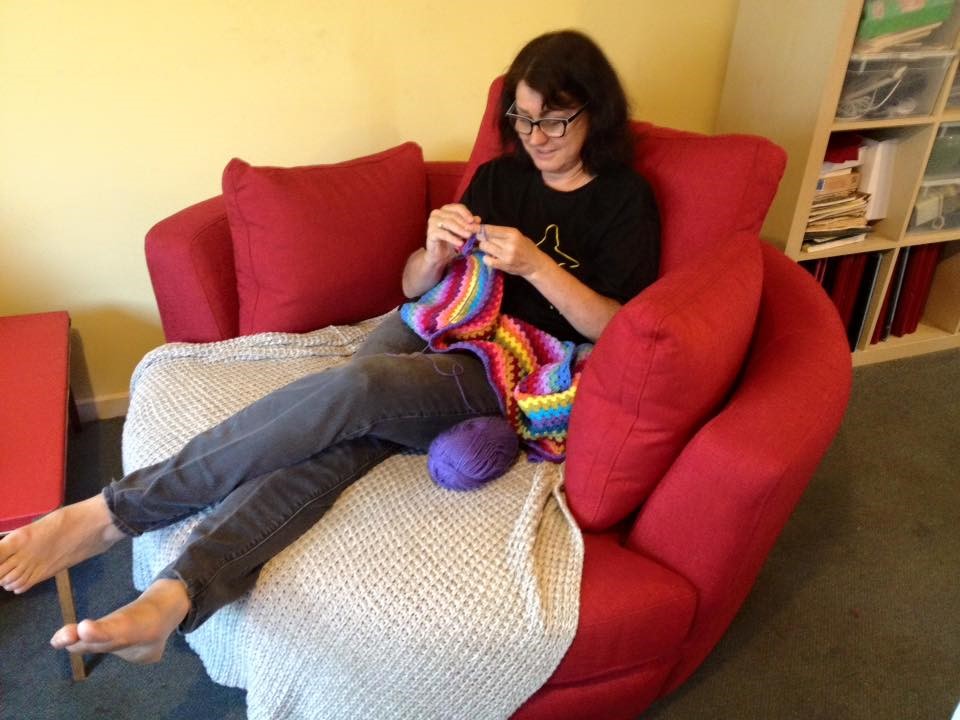
My final word on managing sensory impacts of stroke (for now!) is that it involves spending a significant amount of time in silent stillness to decompress ready for the next onslaught of sensory bombardment. Somewhere in that alone, loneliness, I needed to find a way to reconnect my mind and my body and find peaceful acceptance. For me, that came through craft. I find crafting with beautiful quality natural materials is nurturing and meditative and it soothes many of the unpleasant and painful sensations I experience. Others find this connection and peace through gardening, or art, or yoga, or meditation, or swimming, or running. Some are content in their own experience and many share their experiences in online support groups or blogs. This is a lovely group if you’re wanting to connect with fellow crafters to share tips and successes in all things craft after stroke. If a craft isn’t your thing there are online stroke support groups that align with most interests.
Thanks for sharing a bit of an insight into my life after stroke. This is but one experience of the sensory impacts of stroke, so if you too have sensory loss, please add to the discussion so people can benefit from your experience too. And now I’ll leave you in my happy crafting place…
Read Karen's blog: My early experience of sensory impacts after stroke by Karen B