SMART Arm interview: reaching for success in stroke recovery
Anticipation for the SMART Arm rehabilitation aid is high among stroke survivors, with positive patient reports and successful scientific studies showing how well it can help recover arm function. We recently spoke with its inventors about the device and when it will be available.
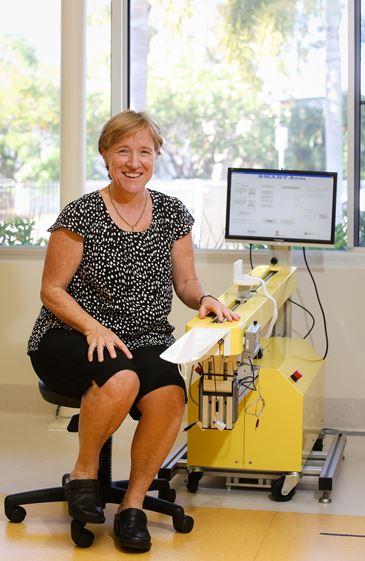
For those unfamiliar with it, SMART Arm is short for Sensory-Motor Active Rehabilitation Training Arm. It uses computer feedback to help stroke survivors increase their reaching range, with or without the added load of weights. There is also the option of electrical stimulation for stroke survivors with severe muscle weakness.
SMART Arm was invented by Dr Ruth Barker and colleagues, from Townsville’s James Cook University and the University of Queensland, and after much development is now being commercialised by its very own start-up company, SMART Arm Pty Ltd.
In 2013, it gained extra attention when it was featured on ABC TV’s Catalyst program, where stroke survivor John Turner talked about the improvement he gained in his left side after only using the device for four weeks.
“Without starting on the SMART Arm, I wouldn't have had any movement,” said John. “I'd hate to think how long it would be before I've got the same amount of movement.”
Case studies like John’s are backed up by scientific research, including clinical trials that show the SMART Arm boosts muscle function in parallel with neuroplastic brain changes. It’s currently waiting for approval from the Federal Government’s Therapeutic Goods Administration (TGA) before it can be widely released.
“At the moment we can only use the SMART Arm under these ethically approved trials,” says Dr Andrew Leech, Chief Executive Officer of the start-up.
“We've got about just under another year or so to go, we think, before we can get TGA approval [as a medical device]. At that point, we will be able sell the device commercially and we'll be looking to put it into public and private hospitals that have rehabilitation units, physiotherapy departments and so on. Hopefully, private physiotherapy units as well.”
You can hear more from both Andrew Leech and Ruth Barker in their recent chat with the National Stroke Foundation’s Rachel Murphy. Listen to her interview, download the audio or read a transcript below.
The SMART Arm project has received seed research funding from the NSF. For more information on the device, see http://smartarm.com.au/
Download the SMART Arm interview (MP3 6.8 MB)
Transcript
Rachel: Thank you so much for taking the time to have a chat with us about the SMART Arm. It's something our community is very interested in. Andrew, perhaps to start, are you able to tell us what SMART Arm actually is and how it works?
Andrew: This is probably best answered by Ruth. Ruth has been, really, the initial inventor and the driving force behind SMART Arm for the last 8 or 9 years now. So, I will throw it over to Ruth to describe the SMART Arm and how it works.
Ruth: The SMART Arm is a training device to promote upper limb recovery after stroke. It's a mechanical device that just sits on the ground and that you sit beside. The person's arm is strapped to it. Then they have a computer monitor on, which is an interactive computer program that basically drives their training. The mechanical component on it, the key thing that is on it is the track, that the person reaches along the track to achieve a goal. If they have no movement or little movement, they use the SMART Arm with electrical stimulations to assist with either reaching of the arm, and/or opening of the hand as well.
Rachel: OK. Does it matter how much movement would be in someone's arm or do you have to have a minimum level of movement to use SMART Arm?
Ruth: No, a person doesn't have to have any movement of their arm to use the SMART Arm.
Andrew: I'd just like to throw in there, from the business perspective, because that is what I really handle for SMART Arm, we think that is really one of the major differentiating points between our device and other devices on the market. It allows those patients to cross that 'no function gap' a lot more easily than some of the other devices or even conventional therapy.
Rachel: Great. Have you seen examples of stroke survivors who've had very little to no movement in their arms, how has the Smart Arm helped them achieve the movement?
Ruth: I think that, the critical thing, first of all, is that it enables them to practice. We know that practice is the critical component to achieve recovery. And stroke survivors with no movement or very little movement, the problem they have is they can't do enough. They haven't got enough movement to actually practice. So, they can't get started. What the SMART Arm does is, this is where it came from in the beginning as well, is that it actually enables them to practice in a way that they otherwise wouldn't be able to do. That is the first thing, it allows them to actually explore their potential for recovery.
Then, going on from there, they’re certainly then able to practice. Because the SMART Arm training program automatically progresses the person's practice based on their performance. As they practice on the SMART Arm, the SMART Arm is gradually motivating them to progress in very very small increments. The goal is constantly being progressed, but still based on their performance. So, if somebody's got very little movement, it doesn't progress very quickly. If someone's got a lot of movement and they're doing really well, it will progress rapidly.
Rachel: Are there any cases where you wouldn't recommend the use of the SMART Arm?
Ruth: It would only be where physical activity is contra-indicated. You wouldn't use it with electrical stimulation if electrical stimulation is contra-indicated.
Rachel: Do you have examples of how SMART Arm is helping stroke survivors in their daily tasks or some cases where it's really helped?
Ruth: The example that I think you might have seen that was on Catalyst is a really good example of a man who, in the first 6 months, he was in the hospital and underwent a lot of rehab. Then, at about the 9 month mark, he had very little movement and next to no function. He did 4 weeks of SMART Arm training and certainly made quite a dramatic improvement. Then, he started using his arm in everyday tasks and he still sends us photographs of his truck that he has done up. Just recently, of him on Harley Davidson with his wife. He is a very good story. There would be a number of stories there.
Rachel: That's amazing. It's incredible. So, he used the SMART Arm fairly early in his rehabilitation. If someone was maybe 5 years, 6, 7, years down the track and hadn't gained much functionality in their arm. Could the SMART Arm still be used to gain some movement?
Ruth: Yes so the very first study that we did was with people that were more than 6 months post-stroke. I think the longest was somebody who had their stroke 14 years prior to the study. We certainly demonstrated that those that used the SMART Arm, improved upper limb function. So, yes it can certainly be used further down the track. We recommend that, when we talk about stroke recovery, the optimal time window being in that first 6 months. Once again, it would be about using the SMART Arm in the first 6 months if possible. Like stroke recovery, if it's later than 6 months, the intervention will certainly work, if possible they might just have to work harder and a bit longer.
Rachel: Where are SMART Arm devices being used at the moment? Where can people access it?
Ruth: They can only access it at the moment in centres where there's a SMART Arm study actually being undertaken. There's a study at Townsville Hospital. There's a study at Community Rehab in Townsville. There's one at Caloundra. There's one at the University of Queensland Neurological Ageing and Balance Clinic. There's an implementation study that will start in the Gold Coast later on next year.
Rachel: So there are plans to expand where SMART Arm are being used?
Ruth: Well, I will hand that over to Andrew, again, because that is on the TGA approval and commercialisation side of it.
Andrew: Obviously, at the moment, we can only use the SMART Arm under these ethically approved trials because the device isn't registered under the TGA as a medical device. We've got about a, just under another year or so to go, we think, before we can get TGA approval for the device. At that point, we will be able sell the device commercially and we'll be looking to put it into public and private hospitals that have rehabilitation units, physiotherapy departments and so on. Hopefully, private physiotherapy units as well. At the moment, we are currently fundraising to get through the next year or to actually get the device on the market. A lot at the moment is really dependent on how quickly we can fundraise to get the device to market.
Rachel: Would there, in the future, be a possibility where the device might be able to be used privately in people's homes?
Ruth: Yes, that is certainly the vision. The current device that we are looking to commercialise and working through the TGA application process, that is designed specifically for use in a rehabilitation service. It's larger. It is catering for people from the most severe. It’s designed for everyone. When we can, we hope to start developing one for home use. Again, it's probably where you’d have options so that you didn't have every bell and whistle on your home one. It would fit in the home more easily as well.
Andrew: From the company’s perspective, our main aim is, obviously, getting the clinical device out there so when patients are in the hospital, they actually get first use of the clinical device. As soon as the company generates enough money to start developing the second home use device, the theory is, we can get a device that's quite a bit smaller than the current clinical device that will be suitable and more easily installed in homes. A patient can probably have their initial training in the hospitals as an inpatient. As they get home, they can continue training, pretty much every day or a couple of times a day sometimes in the privacy of their own homes. We think that will help open up the therapy for a lot more people rather than having to travel into physiotherapy centres or hospitals to be treated as an outpatient.
Rachel: Absolutely. You mentioned the studies that are happening at the moment, Ruth. Are there any early outcomes of the studies that you could share with us?
Ruth: We've had 2 major randomised control parts completed and we've published the data which demonstrates that those people who've used the SMART Arm have improved upper limb function and more than usual care alone. With another study that the results are to be announced at the Australian Physiotherapy Association National Conference of a large randomized control trial, without going into too much, as it is going to be announced, probably the main thing about that is the number of people who had improvement in upper limb function was greatest when they used the SMART Arm with electrical stimulation. Then, coming down to, it was greater than people who used SMART Arm alone. Then, that was greater than people who had just the usual care. It's really saying that, obviously, there are people that have improvements in upper limb function without using the SMART Arm, but more people have upper limb function if they use the SMART Arm and even more if they use the SMART Arm with electrical stimulation.
Rachel: That is great. We look forward to hearing more about that once it's announced. When you're talking about functioning, you mentioned before that it also can be used to improve hand functioning. Is that more fine motor function or more gross movements of the arm and shoulder?
Ruth: The initial device design relates to, as I said, it's about getting people started and enabling people to practice so it was initially focused on reaching, more than on the hand function. Over time and with the development of the next version, it's also focused on hand function. It's basically using the SMART Arm to assist in the transport of the arm to then use the hand. In using the hand, it's more that the therapist needs to design the task that the person is doing and put those tasks on the SMART Arm and make it part of the SMART Arm training. What we envisage is, again, with improvement in the software, more of the hand function will be incorporated into the software design as well. By that, it is dictating to both the stroke survivor and the therapist of how to progress through that. At the moment, yes the hand is definitely used but it's more about the skill of the therapist or the stroke survivor to use it with the hands. But definitely in the future and well even in the version that will be commercialized next year, We would hope to have more of that in the software.
Rachel: I imagine that would be really helpful, particularly if you're looking to develop the tool to be used in the home. Having those kinds of features would be really really useful.
Ruth: Yeah, because then it's not so individual and independent. If it’s there in the SMART Arm and people are prompted to do the activities then it's more likely to happen and also it's prompting them to do the activities but the software also prompts them to progress their practice. Both of those things are really important: there's lots of practice and that the practice is incrementally progressed. The SMART Arm does both of those things.
Rachel: I imagine we'll get a lot of interest from stroke survivors and their families and probably health professionals as well. If people want more information about the SMART Arm or want a referral, where should they go?
Andrew: We direct everyone to the new SMART Arm website, that is SMART Arm.com.au. There, it tells a bit more about the SMART Arm story but we've also got a facility for 'capturing interest' from clinicians as well as stroke survivors. If they put their details in there, we can collect the details and we will be sending out periodic updates to let patients and clinicians know how we are going with getting the device to market.