STROKE RECOVERY – THALAMIC PAIN

This article is an extract from my book, page 244.
Thalamic Pain Syndrome: Post-stroke pain affecting a deep structure in the brain – the thalamus.
The thalamus receives and integrates incoming messages to the brain (pain sensations, crude touch and temperature), resulting in distortion of these incoming messages, which are then erroneously transmitted as pain; probably similar to a ‘phantom’ pain. The words most frequently used to describe the pain are ‘burning’, ‘shooting’, and ‘throbbing’. It may affect half the body or it may involve only a small part; sometimes the hands and/or feet are more severely affected than the arms and legs. For Clive, the pain affected half his body: his hemiplegic side.
Thalamic Pain, (sometimes referred to as ‘nerve’ pain), affects some two per cent of people with a stroke; for some, the onset may be immediately after a stroke, although usually the pain does not come until sometime later – it has even been as much as two years later. There is a greater tendency for this type of pain to occur in younger people (those who have their stroke under the age of 60), as did Clive.
At the best of times, Clive’s pain registered as a three on a scale of zero to 10. Then without warning, it would escalate and register as a seven or eight on the scale. This sudden increase in intensity reduced Clive to tears: he would cry, rocking his body to help alleviate the pain. One of the most remarkable features of this pain: it rarely interferes with the victim’s sleep pattern. The only way to get relief from the pain and experience a little peace was to lie down and try to sleep; but when Clive awoke the pain would still be there: there was simply no escape. This condition also contributed to and acerbated Clive’s depression.
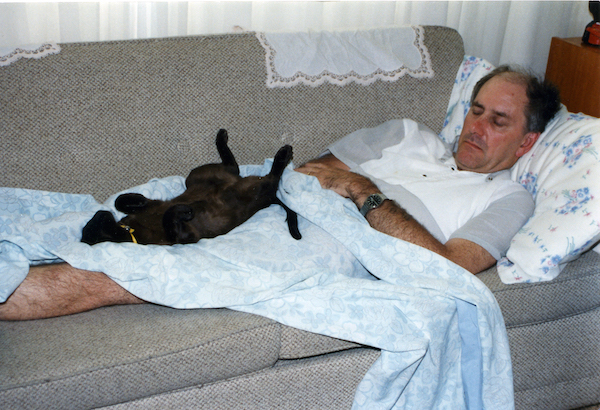
Clive and Temaku - Dark Days
In 1991 when Clive experienced his stroke drugs had little impact on the condition. After making enquiries and researching possible treatments; (at the time of Clive’s stroke and due to the nature of the pain), there was little on offer to give any guarantees to control the pain on a long-term basis. Clive and I experimented other ways to relieve his pain: we really had nothing to lose.
The Stroke SA support group we attended put me in touch with a physiotherapist who had some success with chronic pain by using a Likon™ machine, (similar to a Transcutaneous Electrical Nerve Stimulation [TENS] machine). I was shown how to operate the machine, which we hired and used daily for some time; but for Clive the benefits of treatment were short-lived. The pain eventually became resistant to the treatment, resulting in no relief at all; we were back to where we had started. At first Clive experienced some relief, though not absence of pain; which we thought was better than nothing.
Another treatment I hoped might be of some benefit was acupuncture. Clive embarked on a very intense, controlled course for a period of three months. The acupuncture gave Clive relief from the pain, but his hemiplegia side remained very sensitive. I am also of the opinion this combination played an important role in controlling his seizures and helped with his depression: with the combination of medication and acupuncture, Clive became ‘seizure free’.
Disclaimer:
Although in this article I have mentioned what Clive found beneficial for his treatments for thalamic pain and epilepsy; it must be remembered that what works for one person may not be beneficial for another. I have merely shared Clive’s experience and not offered medical advice and/or treatments. Technology has most certainly improved and moved forward since I wrote and published my book.
Always consult your medical practitioner and/or therapist for appropriate treatment.
©Carol Rosemary Fuller
Author: Echoes of a Closed Door – A Life Lived Following a Stroke
Available in print on Amazon.