My promise to my family - By Nicole

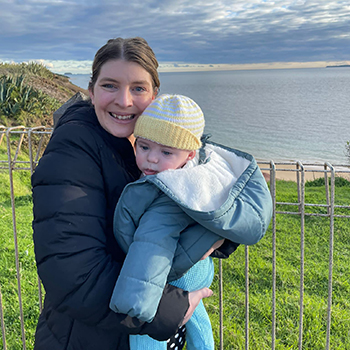
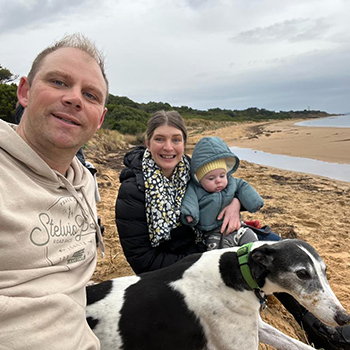
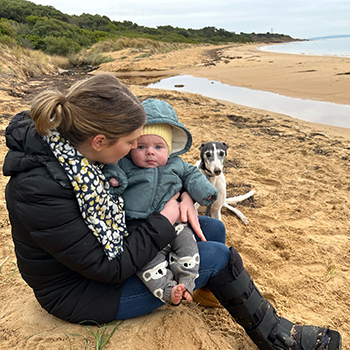
Photos are from a family trip to Phillip Island. It is the first time that Nicole was able to stand and hold Gus at the same time. We're so happy for Nicole to reach this goal.
By Nicole
I was 22-weeks pregnant and home alone when I had a severe headache on March 19, 2020.
I tried to call my husband Dave, we are both teachers, but he was unable to answer his phone as he was in class.
I called my parents, I was terrified, I was losing my speech and I could no longer stand – I collapsed mid-call.
They called an ambulance and two ambulances rushed to the house and had to break through the side door of the house to get to me.
I was rushed to hospital where it was discovered that I had an AVM (an abnormal mass) on my brain. It had erupted.
My family was told that I may not make it through to the morning. Dave faced the prospect of losing both his wife and child.
Devastatingly, our baby boy, Ned didn’t make it through the stroke. He was stillborn - too little to make it.
After the surgery I was in a coma for six days. Then, a week later, the tubes were taken out of my throat, and Dave was able to tell me that we’d lost Ned.
I cannot fully fathom what Dave had to go through, those early days were horrific for everyone, but Dave had to hold it together for us all, it’s unbearable to think about.
After the stroke I had to learn how to eat, talk and walk again. I spent many months in rehab, and it has been a long road back, but as we know life has a way of surprising you. We found out that we were expecting another baby a year and a bit after the stroke, and Gus came into our lives.
Holding Gus in my arms for the first time, I was absolutely overwhelmed by love. I promised myself that I would be the best mother that I could be. My focus is for Gus to grow up in a happy and loving family, and to one day know that he has a big brother called Ned.
Being a mother is the best thing that I have ever done in my life, and although sometimes frustrated with my limitations, I have found a way around most of them.
Here is what I have learned. I hope that it may help another family who are parenting after the trauma of stroke.
What advice do you have for future parents thinking about having a baby after a stroke?
It’s possible.
When my stroke happened, I felt like my world was crumbling down around me and that my life was over, but it was really just beginning.
I utilise all the help offered, and I will always ask for help.
Sometimes mothering requires a little bit of extra consideration and workshopping. I’m very fortunate that I have a committed physiotherapist. We trial many things to work out what is the best and safest way for me to look after Gus.
My balance is still not fabulous, so walking around with Gus in my arms doesn’t feel safe. In the early days I would walk from room to room with Gus in his bassinette. Now he is bigger, I use a travel pram.
To change nappies, I use the portable change mat and place it on our bed and kneel.
For play, Gus has his playmat on the bed also. I don’t put him on the floor, as it would be difficult for me to pick him up.
I have learnt that I’m so much more capable than I give myself credit for. Having a plan and trialing how to do things has boosted my confidence.
There is actually nothing I can’t do; things look a little different.
How does Gus help to motivate you in your recovery?
Gus is the best motivator; I want to be the best mum I can be for him.
Recently I was sitting on the floor with the mums from mothers' group which I found really difficult. I simply don’t have the core strength to play on the floor.
But it is something that I am determined to do, so I have set a goal with my physio to work on my core strength. My other goal is to get my driver's license back.
What have been your biggest challenges as a new parent?
Lack of sleep and the dreaded fatigue.
I think all parents experience fatigue, but I imagine stroke fatigue with a newborn is a whole other level. Those days when Gus had three-hourly feeds were rough, but the body is an amazing thing and it’s incredible what you are capable of.
He is an absolute superstar and has been sleeping through the night for the past two months, getting a proper night's sleep is making a huge difference.
Because I lack coordination in my right side and have an intention tremor in my right hand, I made the decision to exclusively express. I felt more confident doing this. But I quickly learned to put plenty of time aside, it took ages. Then I broke my ankle so that was the end of breast feeding.
I wanted to breast feed Gus for longer, but I have found that formula is easier, and I get more rest, which is important too.
Being kind to yourself is vital and if there are ways you can make things easier that don’t compromise the wellbeing of your baby, then absolutely do them. In the end that’s the best thing you can do for your baby, as they benefit from a happier and better functioning parent.
What have been some of your most cherished moments since you had Gus?
It’s hard to pick because every moment is so special.
The first time I walked Gus in the pram with Dave by my side is a moment I’ll cherish forever. For every mum there are incredibly special moments like your child meeting your parents for the first time. This was so meaningful to me because not only was it a wonderful moment with my two favourite people, but it was also a significant personal milestone for me.
We asked Dave to answer some questions from a partner’s perspective. Remember stroke doesn’t happen to an individual, it happens to a family.
What are your two top pieces of advice for people who are supporting their partner in parenting or life after stroke.
Be patient.
The journey requires patience. It's important to understand that recovery and adjusting to life after a stroke can be a slow and challenging process. Things may not progress as quickly as you hope, but with time, they will get better. Instead of becoming frustrated, try to empathise with your partner's experience.
You will become frustrated with little things at times but remember that things are a thousand times more frustrating for them. By remaining patient, you provide a supportive environment that can aid their recovery and overall well-being.
Maintain strength and positivity.
Supporting your partner through the aftermath of a stroke requires strength and a positive mindset. There will undoubtedly be numerous challenging moments, setbacks, and difficult times. In these moments, it's essential to be strong for your partner and maintain a positive attitude. Remember, life after a stroke isn't the end, things are just different.
Focus on the positives, celebrate the small victories, and help your partner do the same. There might be times when they may struggle to show their own strength, but by being strong and positive yourself you can help uplift them. Together, you can navigate the ups and downs, finding strength in each other.
Remember that your role is crucial in their journey toward recovery and rebuilding their life.
------
Finally, we want to thank the doctors at The Mercy who took such great care of me during the pregnancy journey and were so thorough that I felt very reassured.
To my amazing physio who has been brilliant at talking through obstacles and brainstorming safe solutions with.
To my carers who have helped take Gus to appointments or ensured I was able to attend mothers’ group which is so very important to me.
A last word from Dave
I want to thank my wife, for her courage, determination and will. When things have been difficult, when she has been faced with the worst, most difficult moments of her life she has pushed through and worked hard.
Anyone could have easily given up on multiple occasions. Anyone would be forgiven for being miserable and angry at life.
Nicole has approached everything positively with a ‘can do’ attitude.
“I’m the tortoise not the hare”, was a mantra of hers when she was at the rehabilitation hospital for so long.
Things have been slow. The tortoise moves slowly. But the tortoise wins the day. Nicole has had challenging moments and devastating moments. She has had setbacks, but she has had wins along the way. And the biggest win is our son Gus.
Nicole has accepted her life has changed but does everything she can to get better and everything she can to be a good mum to Gus.
Her courage and determination have been inspiring to watch, and I am immensely proud of her.