Reflections

Well, here we are again, almost another year has passed us by. Where has this year gone? What have we done in this past year? How far have we journeyed? What will the future offer? We are constantly looking for answers.
It is Stroke Awareness week 4th – 10th September. The word ‘STROKE’ for many, translates into fear, heartache, helplessness and sometimes hopelessness, and to be realistic, unfortunately for some - death. A cataclysmic event that alters the lives of not only the person who has had the stroke, but their family, friends and carers.
During this week, perhaps take a little time to reflect back to day one of the stroke. Take stock and honestly look at that journey - ‘from whence we have come since day one of the stroke’. Look at the gains during that difficult journey and don’t get hooked up on the negatives: ‘I haven’t regained as much as I thought I would’. ‘It’s taking too long’ etc.
As we all know every stroke is different. There are no two strokes alike: they are as individual to that person as their fingerprints. Due to the severity of damage to the brain, progress may be slower than anticipated. There are no set time schedules for the return of ‘anything’. There are no miracles at the ‘snap of our fingers’: it is hard work in conjunction with the therapist. This hard work may surprisingly yield results through relearned behaviour, repetitive tasks forming new pathways in the brain, allowing the ‘return’ of a function. Unfortunately, for the impatient, changes (if at all possible), will filter back into lives in their own time, at their own pace. We all need to take on board ‘patience’ and be kind to ourselves.
Clive suffered his near-fatal stroke at the age of 50 on 21 September 1991 and sadly died on 26 September 2012, his death was not as a result of his stroke, but a diagnosis of terminal cancer: he was tragically robbed of the life he worked so hard for during his 21 post-stroke years.
Through my experience, I have been associated in some capacity with strokes for a period of 26 years. Although these years were very sad for us as a family, they were also years of good times consisting of happiness and hope. My purpose for writing my book.
At the time Clive suffered his stroke, the value of thrombolytic therapy (clot dissolution) was still being debated. The treatment offered then was – ‘supportive’ – wait and see. But now medical science has advanced to enable stroke victims to reap the ‘best on offer’, and for some, make spectacular progress. I often think back and sigh: wishing these new treatments were available when Clive had his stroke. But unfortunately, to do this would be reflecting on the negatives and not looking at the positives we achieved ‘without’ the new up-to-date emergency treatments. Working together, Clive and I embraced what we had, lived a new life and achieved so much.
The month of SEPTEMBER translates for me – the good and the bad. In 1991 when Clive was hospitalised due to his life-threatening stroke; I was walking through a shopping mall where I was handed a brochure from a volunteer – the brochure was on strokes – it was Stroke Awareness Week. That month of September was my initiation into the world of strokes: I have been involved ever since.
As a grim reminder that we all need to take care of ourselves; no one knows what’s around the corner for any of us. I would like to leave you with the following facts and figures about stroke: resourced from the Stroke Foundation’s website:
- Stroke is one of Australia’s biggest killers and a leading cause of disability.
- Stroke kills more women than breast cancer and more men than prostate cancer.
- In 2017 there will be more than 55,000 new and recurrent strokes – that is 1,000 strokes every week or one stroke every 10 minutes.
- More than 80% of strokes can be prevented.
- In 2017 there will be more than 470,000 people living with the effects of stroke. This is predicted to increase to 709,000 by 2032.
- Around 30% of stroke survivors are of working age [under the age of 65]. This equates to around 1 in 3 of the 55,000 strokes each year.
- 65% of stroke survivors suffer a disability, which impedes their ability to carry out daily living activities unassisted.
- The financial cost of stroke in Australia is estimated to be $5 billion each year.
- In 2015, funding for stroke research through the National Health & Medical Research Council (NHMRC) represented just 4.1 percent of the total investment in medical research.
- The FAST test is an easy way to recognise and remember the signs of stroke. Using the FAST test involves asking these simple questions:
FACE: Check their face. Has their mouth drooped?
ARM: Can they lift both arms?
SPEECH: Is their speech slurred? Do they understand you?
TIME: Time is critical. If you see any of these signs, call 000 straight away.
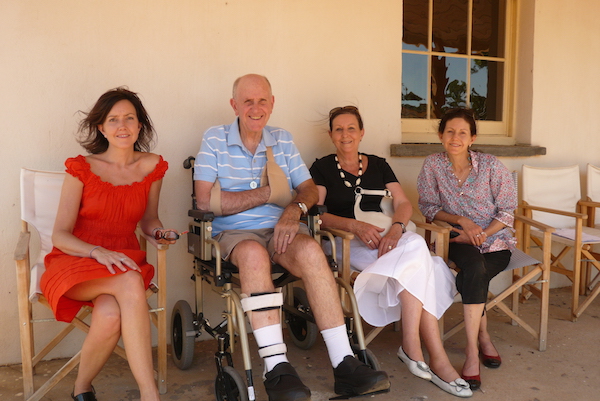
Clive & Family - 21 years post stroke
©Carol Rosemary Fuller
Author: Echoes of a Closed Door – A Life Lived Following a Stroke
