CARING – ‘Tis The Season To Be Jolly?

For most carers, their role is a complex one at the best of times: there are no hard-and-fast rules for caring. During difficult times, carers tend to be guided by their ‘gut feelings’, often having to run on adrenalin – nature’s way of giving them the strength to get through the crisis.
When I cared for my husband Clive I was a working person. I learnt to live from one changing day to the next, forever on guard for the next emergency, working long hours and not having time to think of myself or my own needs. The focus was on the needs of the person I loved and for whom I provided care – Clive.
Festivities, including Christmas, can be a time of joy or a time of sadness, depending on your situation. In the early years of Clive’s stroke, I accepted that Christmas would never be the same again. He was discharged from the rehabilitation hospital on 20 December 1991, just five days prior to Christmas. Christmas Day was filled with very mixed emotions for all of us as a family. Friends and family members called in to extend season’s greetings and to welcome Clive home. Although Clive appreciated their thoughtfulness, he was sensitive about their seeing the physical changes he had undergone since his stroke. Everything had changed for him, it was not how he wanted to be. He sat motionless in his wheelchair, sobbing. Although he was physically present, emotionally he wasn’t celebrating and he most definitely wasn’t coping with Christmas. Penelope and Sarah our daughters, and I also couldn’t help but compare Christmas prior and post stroke. We knew that we would have to accept and adjust and embrace this new phase in our lives to enable us to move on. This we did.
The cycle of Christmas has come full circle, the holiday season is just around the corner again and it doesn’t seem that long ago since we celebrated Christmas last year: time is flying, and we seem to be propelling ourselves ‘full speed ahead’.
When I cared for Clive, I tried to prepare myself psychologically for Christmas, I kept promising myself on a yearly basis, that this year I would be prepared: have all my cleaning, shopping and menus worked out well before the day. There were a lot of the things on my ‘things to do list’ that I didn’t achieve within the limited time I set myself. I used to worry, and ‘stress’ over not achieving the goals I set myself, and yes, I felt very disappointed with myself. I would soul search, ask myself ‘did I set my goals too high for a total 100% achievement?’
As the years progressed I found that my focus constantly changed as did my priorities. I was Clive’s prime carer, and like most carers we tend to concentrate full time on the caring role of others, and we the carers tend to over-look caring for ourselves; constantly walking on ‘egg shells’ when times are tough or the family is in crises. The ‘tip toeing’ around to avoid ‘rocking the boat’ during critical times becomes stressful, carers become fragile like egg shells, and yes fracture cracks appear on their fragile soul.
Christmas is one of the most stressful times of the year, (so the experts say), if you let it be that is. Although Clive is no longer with us and I am no longer his carer; my full attention is on my immediate family. My daughter Sarah and her husband Stephen are flying from Hong Kong to spend Christmas with Penelope and me; I will be lucky to have my family together in one place. A Christmas gift in itself. I will be focusing on the needs of my family for that particular time, living up to my own expectations instead of trying to compete with the ‘others’ who may be running around like chooks with their heads cut off, spending too much money (some of whom can ill afford to do so), competing with some invisible peer group to get the best gadgetry thing or top designer label in clothing. I am going to sit back and enjoy what I have, a family who loves me and I them.
I will buy gifts, but they will be well selected gifts which I know my family would appreciate and treasure, and not put away in a cupboard because they may have two or three of the same thing. I will ask my family what they would like in the way of food, this way I know I will be shopping for just what we want and not buying extras that may go to waste: let’s face it, money is becoming increasingly harder to come by; spend it wisely.
Holiday breaks for the carer are a time to recharge batteries; a slowing down and perhaps taking that little extra time for self: focusing on your needs. Perhaps it would be a good thing to have a ‘carer’s need’ list; tick off the items on the list for self, and hopefully by the time the holiday break is over, you can at least see that you have spent some quality time on yourself. You don’t have to forget your role as carer, but it is a time when you can step back with a clear conscience and ‘self-indulge’.
I know that sometimes during the year it is difficult for a carer to cope, especially if the carer works. I found it difficult. The working carer is actually running two full time jobs. Cut off times are most essential. I could hear myself saying this when I was working, my conscience poking me in the ribs asking me whether I practiced what I preached, and quite frankly I have to say ‘no’; but I did try to squeeze quality time for myself and took myself off to the gym. It is important to get a good balance; it is not good for the mind, body or soul to have all work and no play!
When I arrived home from work I greeted my husband enthusiastically, I was very pleased to be able to come home to him, but bearing in mind I was taking one hat off and donning another. To cut off from my previous job, I poured myself a glass of wine, poured Clive a lemonade and we had a ‘catch up’ or a ‘happy hour’, not unlike the significance of a full stop in a sentence, the separation from one task to another. I realise that this is not for everyone, but this was my ‘soft fluffy’ for myself at the end of a hard-working day.
In past years when I was a working person, I pushed myself to get all my household jobs done by the Sunday evening, this gave me a fresh start for the forthcoming working week. To achieve this I used to stretch myself like a rubber band, and because of who I am and what I felt was my standard, I used to worry if I didn’t achieve this routine. I came to the conclusion I would not ‘beat myself up’ if I didn’t achieve what I aimed for, I knew the dusting would be there next week and the week after that. The ironing can and does grow to the size of Mt Everest; it is not going anywhere, you will get to it another time. Floors I did clean regularly, we have polished floors and if I didn’t vacuum regularly the dust rolled around like little tumbleweeds. PRIORITISE was my key to coping.
Everyone copes differently, my methods may not be for everyone, but they worked for me.
To the carers, during the holiday season, please take time for self. Sit back and enjoy your celebrations with the people for whom you love and care.
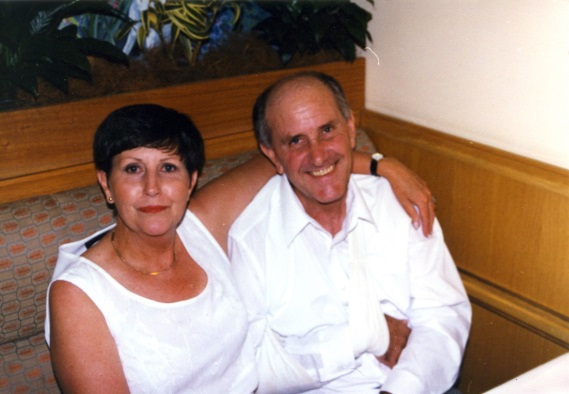
The love of my life and soul-mate - Clive.
Photo taken in 1998.
Carol Rosemary Fuller
Author: Echoes Of A Closed Door - A life lived following a stroke