What you talkin' bout Willis?

After reading ‘What’s in a Word? By Claire Hanney’ I was inspired to share my thoughts on my own experiences of learning to talk again.
One morning while getting ready for work I somewhat suddenly got a massive headache. Turns out it was a fairly large haemorrhage in my cerebellum causing all the trouble. While I struggle to remember specifically the moment when I realized I couldn’t talk anymore, it is definitely a whole process and difficult set of tasks I have some strong memories of – learning to talk again that is.
Like Claire writes about, I still find myself getting words wrong and struggling to find the correct word to say. It is very obvious to me that talking requires much more effort than it used to. By the end of the day I feel ‘shattered’ just from talking. I suspect some people may suggest that it would be better for us all if I just stopped talking so much!
The potential difference in my experience, is the period after my stroke in which I had a tracheotomy. For those that don’t know, this pretty much removes any capacity to talk, even if I could! So, the solution to aid my communication was for me to write messages for my loved ones. As can be seen from the image below my writing wasn’t what you would describe as ‘legible’;
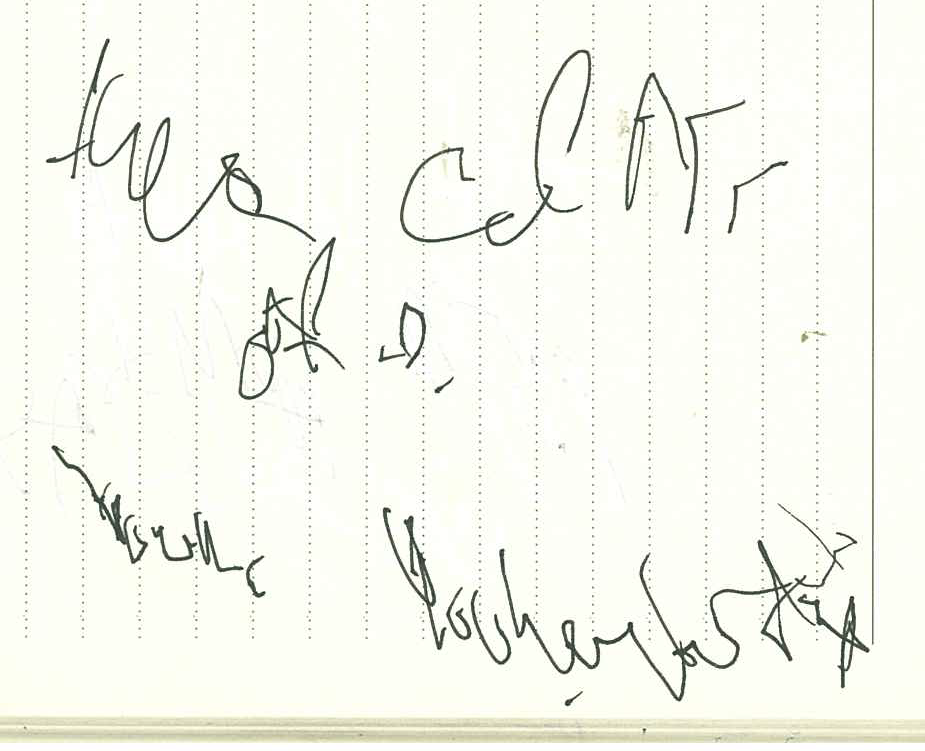
What still makes no sense to me to this day, is that when I was writing this stuff I was absolutely convinced it was clear and beautiful writing. In fact I used to get very angry at my wife when she couldn’t understand what I wrote. How she managed to get anything even remotely useful out of it I will never know! For reference, I have absolutely no idea what I was writing in the above image.
Once my tracheotomy was removed the challenge of regaining my speech begun in earnest. Like Claire, I never really gave any time to the thought I wouldn’t be able to do any particular thing again. Unlike Claire I did not have a history of active sports, but despite this I too thought that my ability to move my arms and legs would return. I thought the same about my speech. My brain could still think the words so surely I would be able to say them again wouldn’t I?
I still have the print outs of the phrases and sentences I had to practice everyday. I can still see the pictures of the ‘things’ I had to say the names of. A coincidence of which I am not really sure was a good or bad one, was that my daughter was just 1 year old and some of the best therapy for me and my speech was actually reading stories to her.
I cannot adequately express how much I can relate to Claire’s experience of retreating from conversations out of fear of getting it wrong and the sheer fact it takes me such a long time to actually ‘get out’ what I am trying to say. I feel I got over this fear with my friends and family, and then when I finally was able to go back to work, the fear started all over again. Surely these co-workers have more important things to do than sit through me struggling for words? And do I actually have anything sensible to say anyway? Despite time lessening my concerns, I still have a ‘crisis of confidence’ fairly regularly wondering if I really should be taking the effort to talk as I doubt anyone actually wants to listen anyway.
Given it was 18 months or so ago, when my speech therapists told me there is nothing more they can do, I just need to keep talking, I feel my speech has improved a lot. In fact a few people have told me that until I attempt to walk (which I still cant do without aids) that people wouldn’t be able to tell I actually had a stroke. This coupled with the semi-regular professions by my taxi drivers that I sound completely unaffected, all makes me feel happy that my speech has returned to normal.
I don’t really know the exact ‘lessons’ I can take out of this experience. To be honest, I really hope there are some. I think the thing that strikes me from reading Claire’s blog and writing my own is that we both seemed to ‘believe’ that our capabilities (speech or otherwise) would return. What exact value this ‘positive’ thinking has on recovery I am not sure. But, stroke recovery or otherwise, I now am a firm believer that the biggest hurdle to actually achieving your goals is to ensure you believe you can do them. Now I don’t want to write some sort of self –help bullsh*t about ‘believing in yourself” but, I am pretty confident that because I never allowed myself to think “I cant do that” means that I now can.
To clarify, for months after my stroke I was effectively bed-ridden, then for a time I could only get around the rehab ward with an electric wheelchair. I now am moving around my home without any walking aids, I rely on a walking frame to walk the 4 or 5 blocks I now can go up to the supermarket. I am working 3 days a week, and being able to play an ever increasing role in the raising of my daughter.
I have never ‘allowed’ myself to think I cannot do anything. Sure, I am now missing a fairly large part of my cerebellum which may mean I actually cant do a few things, but for the most part I still believe I will be able to do pretty much everything else I used to do. Why not?
Sure, I have had to give up my dream of being an Olympic gymnast (to be honest I suspect being 37 with no gymnastic ability may have more to do with it) but I am not prepared to give up on anything else. Neither should you.