Keeping UP! Falls after a stroke

Andrea Grima, APAM
Falls are one of the most common complications that may occur following a stroke. A fall occurs when a person unexpectedly rests onto the ground or other lower level (1). Physiotherapists are also interested in those small ‘trips’ or even the feelings of loss of balance as these may also lead to falls.
Some falls may cause injury and require a person to present to hospital. This may include a bone break or head knock. In fact, people with stroke may have low bone strength because of reduced mobility which increases the risk of a bone break (2). This may lead to more time spent in hospital and a change in how you may normally walk and move around.
Unfortunately, having a stroke leads to an increased risk of falls and having a history of falls (either before or after the stroke) also increases your chance of having another fall.
Neurological physiotherapists are interested in how your stroke may affect your chance of having a fall.
What may cause a fall?
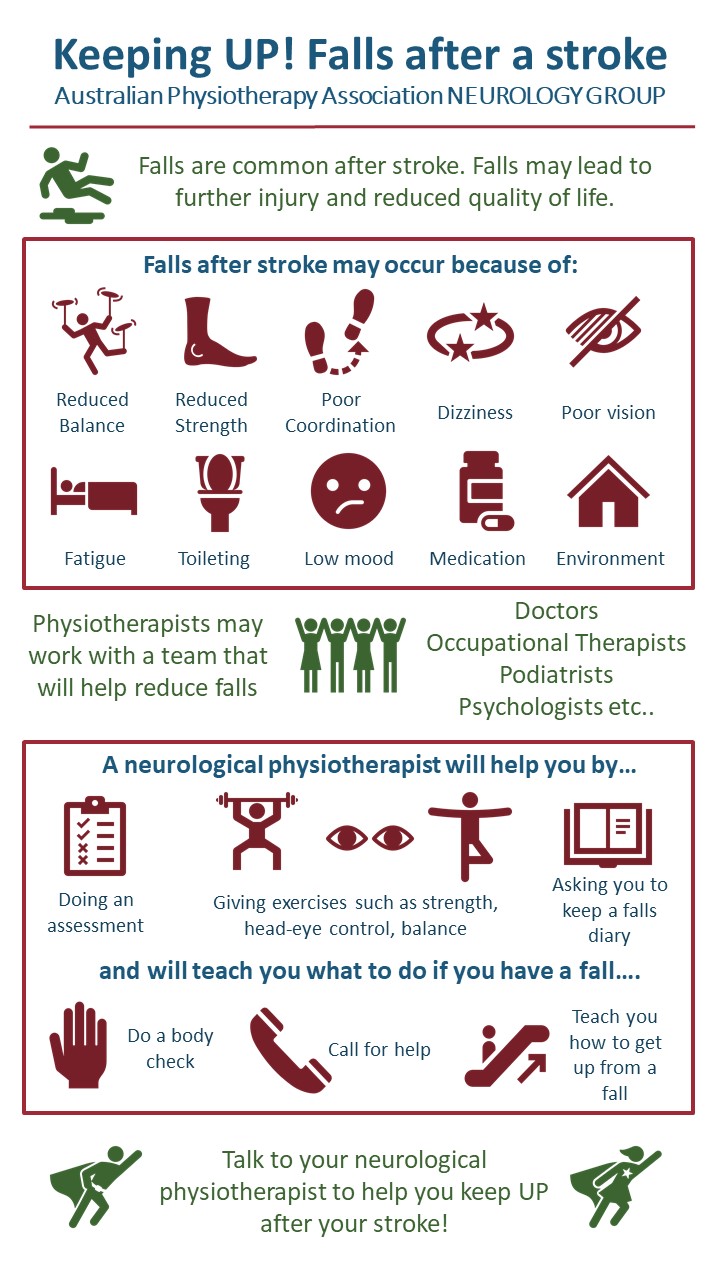
Many things may contribute to a person having a fall. Some of these factors may be directly related to having a stroke, while others may not be. These include (3):
- Reduced balance reactions
- Reduced muscle strength
- Reduced coordination (sometimes called ataxia)
- Increased muscle tightness or spasticity
- Increased fatigue or tiredness
- Changes in vision
- Changes in sensation
- Dizziness and poor head and eye coordination (particularly if your stroke was in the brain stem or cerebellum)
- Environmental factors such as clutter, uneven surfaces or poor footwear.
You may be surprised to know that falls can also be related to:
- Changes in attention to the environment (sometimes called neglect)
- Issues with your bladder and bowel
- Low mood and depression
- Medications
- Other medical issues.
As you can see, there are many factors that contribute to a fall. This is why physiotherapists may form part of a larger team that will help you reduce your risk of falls. This team can include doctors, occupational therapists, podiatrists and psychologists amongst others.
What might a physiotherapist check to assess the risk of falls?
A neurological physiotherapist can help you by completing a detailed assessment. They will look at your walking and balance in more detail. This might be by seeing you walk on different surfaces, at different speeds or walking sideways or backwards. They may assess your balance by seeing how you turn, pick objects up from the floor, reach to different heights or respond to unexpected movements. Specific tests might be used for your walking and balance which may assess whether you may be at a low, medium, or high risk of falls.
The physiotherapist may also check your strength, muscle tightness, sensation and coordination and ask questions around dizziness and vision.
The physiotherapist will also ask you for more information about the falls that you have had. You may be asked to keep a falls diary. This diary will outline where, when, and how you may have fallen. This may help with identifying specific factors relating to your falls. For example, some people may fall at night when going to the toilet. Therefore, further assessment into your bladder and bowel or walking in low light levels may be performed.
What can a physiotherapist do to manage and prevent falls?
A physiotherapy program will involve addressing the specific issues that might be contributing to falls. General exercise such as walking or cycling, are not specific enough to reduce your falls risk. The exercises need to be specific for your balance problems to help manage and prevent falls after a stroke (4,5). A physiotherapy program may include:
- Exercises focused on challenging your balance, balance strategies and reactions – some of these include ankle, hip and stepping strategies, weight-shifting and trunk control (5).
- Specific muscle strengthening exercises
- Exercises to improve the feeling in your feet to better help you know where you are in space.
- Exercises to work on the control of your head and eye movements to help with reducing falls if this is an issue.
- Reviewing your need for a walking aid or other assistive device such as an ankle-foot brace to reduce your risk of having a fall.
You may take part in a Falls and Balance Group which may also address:
- House or environmental set-up
- Medication management
- Mood
- Diet.
How can technology help with managing falls?
There may be some apps and online exercise programs that have been designed for detecting as well as preventing falls. Some examples designed by Australian physiotherapists include the “Clock Yourself” app which focuses on balance reaction times and the “REPS” app, which is a program incorporative of post-stroke exercises. Speak to your physiotherapist about apps or online programs may be appropriate for you.
What happens if I do fall?
Other things that your physiotherapist may assist with is helping you learn what to do if you do have a fall. This includes:
- Doing a body check to see if you may have injured yourself
- Calling for help – carrying a phone or using a personal alarm may be helpful
- Teaching you how to get up from a fall.
Because people with a stroke may have specific challenges with getting up from the floor or calling for help, such as severe weakness on one side of the body or impaired communication, it is important that you speak with your neurological physiotherapist to learn the strategies that may be best for you.
Further information
In the current COVID-19 health situation it is important to continue to monitor your health and wellbeing. If you are experiencing falls, visit your GP or your local neurological physiotherapist. Falls assessments may take place in different ways. This may include face-face therapy sessions or may including telehealth (assessments over video calls) or home visits.
Physiotherapists are always here to help you keep UP after your stroke.
References:
- World Health Organisation. (2018). Falls [Fact sheet]. https://www.who.int/news-room/fact-sheets/detail/falls
- Borschmann, K., Pang, M. Y. C., Bernhardt, J., & Iuliano-Burns, S. (2012). Stepping towards Prevention of Bone Loss after Stroke: A Systematic Review of the Skeletal Effects of Physical Activity after Stroke. International Journal of Stroke, 7(4), 330–335. https://doi.org/10.1111/j.1747-4949.2011.00645.x
- Xu, T., Clemson, L., O'Loughlin, K., Lannin, N. A., Dean, C., & Koh, G. (2018). Risk factors for falls in community stroke survivors: A systematic review and meta-analysis. Archives of Physical Medicine and Rehabilitation, 99(3), 563-573.e565. https://doi.org/10.1016/j.apmr.2017.06.032
- Denissen S, Staring W, Kunkel D, Pickering RM, Lennon S, Geurts ACH, Weerdesteyn V, Verheyden GSAF. Interventions for preventing falls in people after stroke. Cochrane Database of Systematic Reviews 2019, Issue 10. Art. No.: CD008728. DOI: 10.1002/14651858.CD008728.pub3
- Duijnhoven, H. J. R. v., Heeren, A., Peters, M. A. M., Veerbeek, J. M., Kwakkel, G., Geurts, A. C. H., & Weerdesteyn, V. (2016). Effects of exercise therapy on balance capacity in chronic stroke. Stroke, 47(10), 2603-2610. doi:doi:10.1161/STROKEAHA.116.013839