I appreciate every day

By Carolyn (Caz)
I worked in disability services for fifteen and a half years, supporting people with intellectual and physical disabilities to live their best lives in group homes. I did shift work for all those years, which brought with it a tiredness that seemed quite normal to me.
I was working the afternoon shift and felt a different kind of tiredness with visual disturbances that lasted about 20 minutes. After my shift at nearly midnight, I drove home. As I approached the bridge at the entrance of my small town, I realised that I had driven straight past my house. I did a U-turn, went home and put it down to confusion and my usual tiredness - thought no more about it.
A few evenings later, I had a similar visual disturbance, this time I went to the after-hours clinic in the city. The doctor there told me that I was probably experiencing an ophthalmic migraine, to take some pain medication and have a sleep.
A few weeks later, I felt too tired to go to work, so I phoned to say that I wouldn’t be in for my shift that afternoon and I went back to bed.
The next part of the story, I have no memory of at all. My partner, Drew, told me what happened.
Drew was not aware that I had rung work early to say that I wouldn’t be going to my shift. At 11.00am he woke me to get up and get up. He said, "I had a blank and empty expression.” He tried to get me up and dressed, but I seemed confused. I couldn’t speak, I couldn’t follow simple instructions to get dressed. He knew straight away that something was terribly wrong.
Drew took me straight to the local doctor in our small country town. My doctor immediately rang for an ambulance, as he suspected it was a stroke. I don’t think that I had the common signs of a stroke, but as a doctor he knew the less common signs.
The ambulance rushed me to Launceston emergency, and Drew followed in the car.
The C.T. scan showed a stroke. They treated me with blood thinners and did many tests. Eventually I was sent to a ward to recover.
I still had little memory and I was in a state of confusion. - I was absolutely terrified.
Then, Tasmania experienced an earthquake aftershock. I was on the 6th floor of the Launceston General Hospital. That was the moment that I realised something big had happened to me.
The stroke had affected my short-term memory, and I couldn’t find my way back to my hospital bed. I couldn’t remember who or when people had visited me. My partner Drew was the only one constant in my life, and I felt secure when he was around.
After some time, I can’t remember, the doctors sent me to the rehabilitation ward. The aim was to get me to a level whereby I could go home. I had to relearn the most basic tasks, from making a cup of tea, cleaning my teeth, to doing my washing. They even took me to the hospital canteen so that I could relearn how to order and pay for a coffee.
I learned that brain fatigue is very real, memory loss is terrifying, and learning to be me again was going to take time and energy which I wasn’t sure I had. But I worked at it and eventually I was allowed to go home.
I put strategies in place to help my memory. I made up my own drug chart which I could tick off after I had my meds. I took photos of everything I wanted to remember, from outings to grocery products. I had sticky notes all over the house with reminders of what to do, and what not to do. I used the diary on my phone with reminder alarms, and I had a physical book diary to write things in. I would cross reference from my phone to my diary for a more detailed account. When speaking to people, I ask them, …” Did I tell you….?”
I didn’t trust my memory at all, but having strategies meant I could check to see if my memory was correct. But I was paranoid, and I would imagine that people were conspiring and messing with me. They weren’t, it was my brain in a state of confusion, however at the time it felt so real.
Because of my confused brain, I fell down the back steps of my home and I broke my leg. I initially had an overwhelming sadness because I was lost and couldn’t find myself. It took time to realise that I had to get used to the new me. I was still in there somewhere. As time has passed bits of me have returned, just slightly differently. I don’t beat myself up about it anymore, it is what it is.
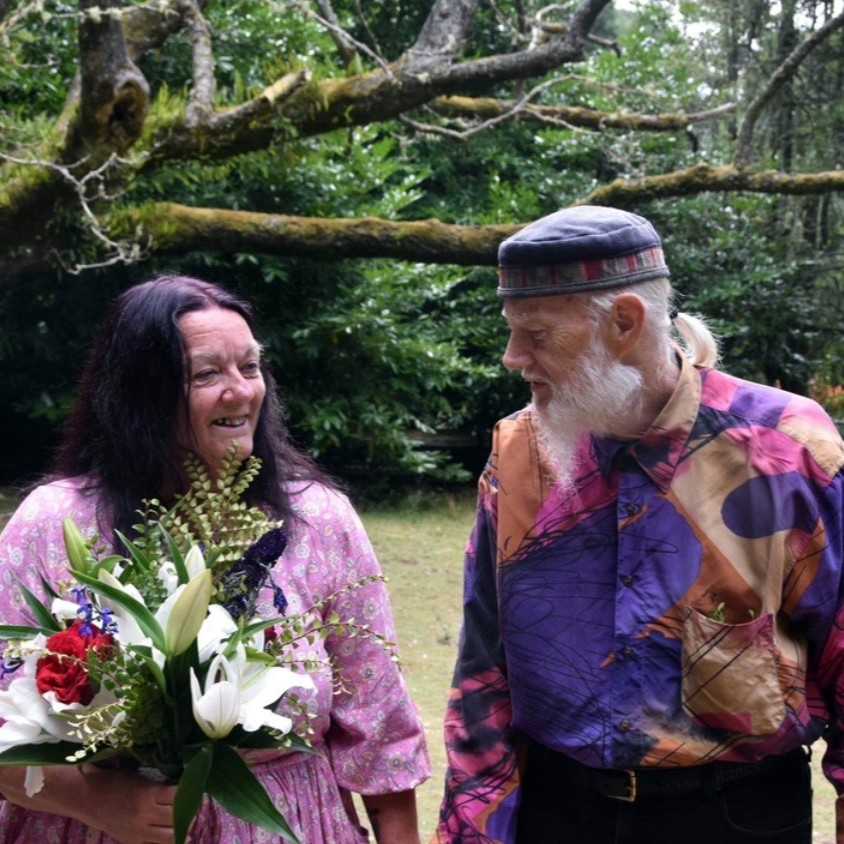
Carolyn and Drew's wedding
Drew and I had a new perspective of life and decided that life is short and to make the most of it. It has proven to be true, as Drew was diagnosed with pancreatic cancer. We decided to get married and embrace each other and our lives. We bought a Harley Davidson and would go riding together. Nineteen months later, after a long painful illness Drew died.
Although I’m filled with sadness at losing my love, he would be so proud of my independence, and he would hate me to wallow in sadness. So, it’s onward and upward, with the wonderful support of my family and support workers. I appreciate every day.