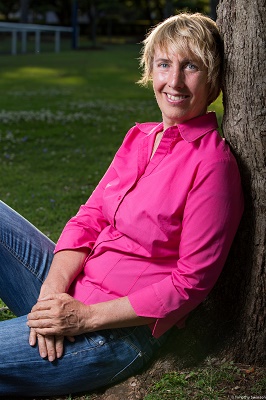
Game, Set, Match by Claire Hanney

Out of the blue, at age 48, I had a stroke. I lost movement and feeling in my right-hand side, and the ability to speak. I had to learn how to walk and talk all over again, and I had no idea how to teach myself.
How did I learn to speak and walk when I was a child? I don’t remember much about it. I do remember that poopies were cows and Grandad was the cinema and I fell over a lot and grazed my knees. Every child gets words wrong and falls over while learning to walk, and at that age it didn’t seem to matter – it was how we learnt. We had no fear, as making mistakes was part and parcel of learning; no-one questioned or judged it. Why can’t we do that when we’re older?
Instinctively we learn by watching, listening and copying others. How often do you see young children mimicking their parents – their gestures, the way they carry themselves, the words they use or the accent they speak with. Then, when they get it off pat, they experiment, learning their limits. At school we learn a different way to learn, it is no longer acceptable to learn by copying or imitation others, we are taught to learn by rote instead.
In hospital, the physiotherapist and the speech therapist taught me by breaking everything down into small chunks. It was a lot to learn, and I felt as though I had to get it right, be perfect. I wasn’t sure I wanted to play the game of recovery, knowing it would be such hard work to win.
After I left hospital I had an hour a week with a speechie. I was fortunate that I had not lost language – I knew which words went with a particular object – but I had lost the ability to pronounce the words, although I could read them in my head. My mouth couldn’t make the sounds, because my muscles and tongue didn’t know how to form them. And I had to relearn how to write, not only the action but also how to form sentences and use correct grammar.
Similarly, the muscles in my leg didn’t know how to move my leg to walk. However, this was easier, as I could see what I needed to do by watching how I walked, either by looking in the mirror or by watching my left leg. To speak I needed to hear the sounds and watch how others spoke. A child learns to walk or talk by constantly practising until it becomes automatic.
I have a nephew who, at 3 years old, could only speak a few words. My brother and sister-in-law were becoming very concerned and had taken him for tests, only to be told that there was no physical problem. One day, on a drive in the car, an innocent remark from my brother about a signpost – where they were going, how far, and hence how long it would take - fired up my nephew. At the next signpost he asked what it said, and from that day forth there was no stopping him from talking or learning to read. We could only assume that linking words to talking about things that he found relevant triggered the change.
The reason I decided to practise was that I didn’t want to be seen as disabled in any way, although this wasn’t apparent at first. The reasons I gave were, first, that I wanted to play squash, and second, who had ever heard of a psychologist who couldn’t speak!
I left hospital angry: angry with the system. I had a belief that the system would take care of me. Mistakenly I thought they would either “fix me” or I would die. Instead I left hospital feeling broken, and I didn’t know how to put myself together again - a bit like Humpty Dumpty. I spent the little money I had on trying to find someone to “fix” me - chiropractors, acupuncturists, naturopaths and so on. It took me a while to realise that it was down to me: I had to take responsibility for my own recovery. No-one else could do it for me, and to recover I had to practise. I was like an athlete going to work, practising in the gym in the morning, fine motor skills at lunch, writing in the afternoon and speaking in the evening.
I wasn’t going to be seen as disabled, I wanted my life back. In the past, goals had never seemed to work for me, even if I wrote them down. Now, however, I knew what I wanted - my “why” and my “must” to help me recover. My “why”? Because I refused to be disabled. The goal in my head was to be as I was before, and I would do whatever it took. My “must”? For my life back I had to practise. And practise. And practise some more.
My “why” and my “must” gave me the motivation to practise day after day, hour after hour. Without that I wouldn’t have recovered to where I am now. What is your “why”? What is your “must”? You need to know; because only with that knowledge will you practise enough to achieve the recovery you deserve.
Related resources:
Listen to the Aphasaia Podcast
Read more of Claire’s blogs