Journey

Journey - what does this word mean: the true definition? When I looked this word up in The Heritage Illustrated Dictionary, it stated ‘To travel from one place to another’.
The word journey is a perfect description of life. Starting at birth and ending at death. A long journey through time, and from one place to another.
Sometimes, our journey doesn’t run according to our plans, or our mapping out of our life’s route. Our journey may run off the road or rails; these detours costing us precious time, sometimes the time being lost forever; but hopefully some of this lost time can be generated into a strengthening and insightful experience. This insightfulness may not be obvious at first, but as we make our plans to re-route our journey we can be pleasantly rewarded: it depends on how we interpret the experience.
This new journey for us came to the fore when my husband Clive, who at the age of 50, experienced his life-threatening stroke in September 1991. Our life most certainly derailed, and we both wondered if we would ever get back on track again. It was most certainly a cataclysmic change. The life we had previously made for ourselves, and had taken for granted - that it would be a life we would share ‘forever’, was now very much in question.
As the years passed Clive and I tried extremely hard to make a meaningful life for us both to share; to get our new life on track again; but to do this we had to re-route our journey and carefully step around the pot holes, loop holes, disappointments and challenges which continually confronted us. I have been able to sit back on the outside and watch Clive journey through some of his most ‘off track’ times. I watched with admiration just how much of a struggle it took him to re-map another route, and pick up on his life’s journey again. Bumpy as this new start was, this starting and stalling period of his life was not what he wanted or planned, but it was an essential part of the journey. I have watched the tears flow, the look of pain and unbelievable sorrow etched in the expression on his face: the sheer helplessness of his situation. I too felt not only for his sorrow but also mine. I too felt the pang of helplessness and the feeling of hopelessness.
Clive and I were married in 1962, he had his stroke in 1991: the first phase of our journey we had shared for 29 years. As a result of Clive’s stroke, we both knew how fragile we both had become. The second phase of our journey 1991-2012 (21 years) was the most difficult part of our journey – what I call the ‘bumpy phase’: it was most definitely not a ‘short detour’!
People who experience a catastrophic illness of this nature really suffer. They go through the most terrible chaos and pain (physically and psychologically): I would label it as excruciating pain. And yet, in this phase of their journey, when they need all the help and support they can get, some are shunned. Shunned because some members of our society have no knowledge of strokes, they don’t understand the underlying disabilities, therefore in their eyes ‘they are different’. This label or stigma is most harmful. Perhaps it is thought that it could be ‘contagious’. I can assure you it is not; but the stigma associated with the illness is. If it was contagious, I would have caught it years ago! Society can be so selfish; something seems a little different, therefore it is not acceptable by the so-called ‘normal’ members of our society.
First of all, we should educate ourselves before we judge a person. There is a saying my mother always used to hammer home to me when I was a child. ‘Don’t judge a book by its cover!’ So, I don’t. I look for the hidden text; the story encased by the disposable dust cover. I look for the soul of the cover, and I don’t judge the book until I have understood the text: the journey of the book and the map of the dust cover. Just because some people who have suffered a stroke may look ok and ‘intact’ on the outside; like a glossy dust cover, travel brochure or journey map, it doesn’t mean that the road they have travelled has been smooth sailing.
People like Clive who embarked on their journey of life after a stroke, are, in my opinion the true ‘journeymen’ of life: they are to be commended for their achievements.
It is Stroke Awareness Week 4th-10th September. Please spare a thought for those who have experienced a life-changing stroke and their carers; try to step into their shoes and reflect on how much their journey in life has changed their world.
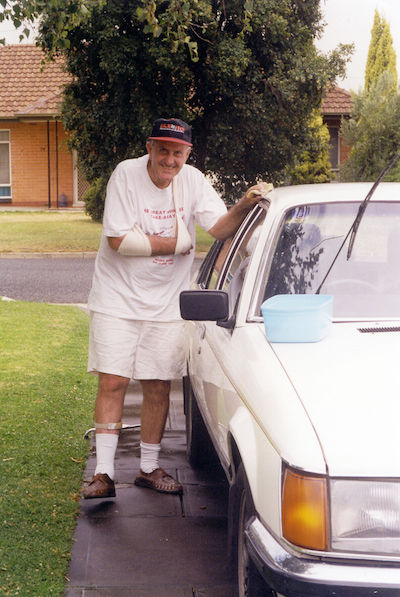
Clive washing the car (after his stroke)

©Carol Rosemary Fuller
Author: Echoes of a Closed Door – A Life Lived Following a Stroke