Stroke and recovery by Hugh Evans

On April 15, 2015, a few days after my 74th birthday, I experienced a devastating stroke. Fortunately, it occurred when I was visiting the emergency department at Methodist Hospital in Arcadia, so doctors were able to give me immediate attention. Two days earlier I had had an operation at Kaiser Permanente Hospital in Los Angeles to repair a hernia and was having trouble inserting and removing catheters. I was unable to urinate normally in this resulted in excruciating pain. Staff at Methodist informed Kaiser of my predicament and after a few days, I was transferred to the Kaiser facility on Sunset at the Los Angeles medical center.
At the time of my stroke, I lost consciousness and all sense of what was going on around me. My wife Emily immediately called her close friend Marie for help, since she had only recently arrived in the country and her English was still limited. Marie called my daughter Mito in New York, who took the earliest flight at 6am the next morning to join us in Los Angeles.
A note in my file dated 6/02/15 by Dr Salas states: "Resident (me) is unable to walk or properly care for himself due to impaired cognition and other medical conditions". I did not fully regain consciousness until eight weeks later in mid June. It was an agonizing time for my family and friends, and all concerned. Despite repeated enquiries, the neurosurgeon at Kaiser, Dr Brian Pikul, would not offer a prognosis saying he simply did not know what the outcome would be. As a firm believer in the Almighty, my wife had no doubts from the start that I would recover, but my daughter and many others were less confident.
My wife Emily watched my progress closely and took an apartment near the hospital to visit me two or three times a day. My daughter Mito took an initial leave of absence for three weeks from her job with NPR in New York to be close at hand and made later several shorter trips as best she could.
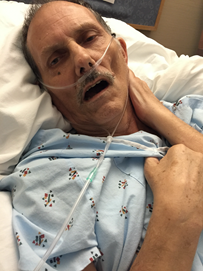
During the weeks I was unconscious I was kept alive with a whole array of pipes and tubes that supplied me with water, food and drugs while extracting waste. It was at this time that I remember having frequent nightmares in which I called for help from nurses who never seemed to respond, or only after a long delay. It felt like a form of torture, and I couldn't understand why it was allowed to happen in a hospital. Through my dreams or perhaps semi-consciousness I remember struggling to untie large bandages bound around my hands. I was told later that these bandages were applied to prevent me from ripping out the tubes and pipes connected to my body. This limbo land was a most unpleasant experience, but fortunately it ended after I recovered consciousness and was able to see and talk to real people instead of the phantoms of my dreams.
After three weeks on 6 May 2015, when my condition was considered stable, I was moved to Fountain View Subacute and Nursing Facility on Fountain Avenue, not far from the hospital. On arriving there, one orderly told me later that I looked like nothing more than a vegetable with little sign of life or responsiveness. My wife tells me that I remained in this state for another four weeks or so, occasionally responding with half opened eyes and a week squeeze of fingers. It wasn't until a month later in mid June that I started to regain consciousness more fully. During this prolonged period of inaction, the nursing staff successfully managed to protect me from many ailments that bedridden patients often encounter, such as pneumonia, bedsores, and infections of the urinary tract.
Of my surroundings, I remember nothing of the room I stayed in at the hospital on Sunset, but I do clearly remember the room I stayed in at the nursing home. My daughter, Mito, hung a string of little lights across my cubical and arranged on the wall several photos of family and friends. These cheered me greatly and attracted many favorable comments from staff and visitors. This room I shared with Edwardo, a fellow from Mexico who had broken several bones in his legs from a car accident. Although I speak Spanish, which I had learned from living in Mexico and Bolivia, we didn't speak much since the stroke had more or less closed off that part of my memory.
My stay at the nursing home, which lasted more than three months, was a time of rehabilitation to regain weight, recover strength and repair faculties damaged by the stroke. After starting with a bland diet that was easy to swallow, I soon graduated to much more appetizing food that was surprisingly tasty. When I left the room to be bathed every two or three days by Jorge from El Salvador, or to visit the gym for physical therapy, I was pushed around in a wheelchair by Reina, one of my nurses, until I grew strong enough to start learning to walk again.
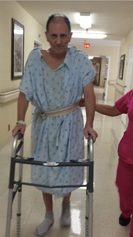
For that I used a walking frame equipped with two wheels that I pushed in front of me. Reina tied a rope around my middle and following close behind to make sure I didn't fall. Early expeditions went only as far as a couple of rooms next to mine. Gradually as I regained strength I reached further to the end of the corridor and eventually around the whole building back to my room. At first, I found those trips exhausting and was glad to collapse thankfully back onto my bed.
One room where I spent a lot of time was the gym for physical therapy. Vladimir from Russia routinely used to drag me reluctantly out of bed for exercise. Despite his dubious sense of humour, I grew fond of him and owe him a lot for repairing my weak physique. The close attention and sustained support from the staff at the Fountain View nursing home rapidly improved my strength and allowed me to return home at the end of August 2015. I am especially grateful to Dr Raphael Salas, Director of the Fountain View Subacute & Nursing Center, and the many staff that looked after me while I was there.
Later after returning home, I continued physical therapy with visits to Kaiser on Sunset. There I completed several months of speech therapy with Gretchen Jaeger. She worked wonders in helping me to recover my ability to read using paper windows and flash cards, and to write using dictation software. I was amazed how the dictation software had improved so much since I first tried to use it several years ago.
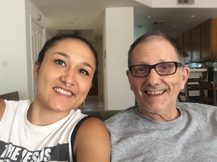
(The photo shows me at home again with my daughter Mito.)
In December last year (2016), just before Christmas, I suffered a minor relapse after losing my balance and banging my head on a wall at home. I thought little of it at the time, but my wife Emily insisted I check things out. A CAT scan at Kaiser in Pasadena revealed a small bleed in my brain. Arrangements were made to transfer me back to Kaiser on Sunset for a more detailed examination. I spent four days there in the intensive care unit to monitor my vital signs and make sure nothing more serious was happening.
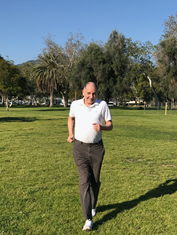
Fortunately, my condition remains stable, and I was allowed home, but I did notice changes. The biggest impact, as was also the case right after my stroke, was the need to sleep a lot during much of the day. The urge to sleep and a general lack of energy means that I have accomplished little during the past several months since my stroke. However, in retrospect it seems that the rest has been necessary to allow my brain to heal itself. The bang on my head also weakened my balance although this has since improved considerably. At the start of spring in early March this year, for the first time since my stroke, I was able to start jogging again. This is not my favorite form of exercise, but I was thrilled to discover that I could do it slowly without losing balance as was the case the last time I tried before the cold days of winter in late October last year put an end to my attempts. (The photo shows me jogging in the park in Arcadia where I live.)
The most important initial step towards my recovery was undoubtedly the wise decision by Dr Pikul, my neurosurgeon, and his team, to avoid surgery after the stroke and instead to allow my brain to work its wondrous ways of healing itself. This was a courageous decision since it was by no means certain that the strategy would succeed. As it has turned out, this decision has proved convincingly to have been the right one. I have made what several people, including doctors, have described as a remarkable recovery. Some more religious friends have described my recovery as a miracle. However, it is described, I have escaped any paralysis of my limbs or loss of sight, speech, or hearing, which others often suffer after a stroke. The only significant damage that remains today two years later relates to physical balance and the loss of some vocabulary and short-term memory. Compared with others I have heard about, my recovery from a serious stroke can only be called extraordinary.
For this my heartfelt thanks go to Dr Pikul and his team of talented colleagues in the neurology department at Kaiser. I don't have all the names, but I understand that some of the members of the ICU neurosurgery team that helped me include Dr Zhou Zhang, Dr Paul Didomenico, and Dr Michael Allan Bronstein, director of the ICU.