The Power of Language

How many of us overlook, take for granted or underestimate the power of language? Language is a wonderful gift; something that should never be taken for granted. Language is a way to communicate an important event, tell a story, express how one feels: it is a process to get an important message across from one person to another. One could say a precious gift; but for the majority of us it is something we just take for granted. It’s not until something happens like a catastrophic event; either from a stroke or other accident, which results in this wonderful gift being stolen from us. I would describe this incident as an invasion – an unwelcomed act of theft – for me; that is what I personally translate a stroke to mean – a thief!
I consider myself extremely fortunate; when time permits, I am privileged to sit in the peace and quiet and read a poetic story. I admire people who can put pen to paper, and with a few words convey love, thoughts and events into a ‘shorthand’ language that everyone can understand; a few words that speak a volume: a piece of poetry. The written and spoken word is truly a wonderful gift.
When Clive experienced his stroke in 1991, this wonderful gift of language was stolen from him. Almost a lifetime of learning gone; he was left with severe receptive and expressive aphasia. He knew what he wanted to say, the words were on the tip of his tongue, but the pathway to complete the process was severed. Clive could not read, write or speak: he had a lot of hard work to do to try to regain some language.
The brain is a mysterious, wonderful, powerful organ. It is very smart. With hard repetitive work over a long time, new pathways can be regenerated; this was the case with Clive. But whilst this hard work was taking place, Clive needed to find some way to communicate during this difficult phase; when he was trying to retrain areas of his brain. To overcome the isolation and frustration and to compensate for the loss of language, Clive relied on charades and in early days, primitive stick drawings – his way to communicate what he was trying to say or ‘tell his story’. The method he developed for himself helped him to infiltrate back into the world of language. Language can come in many forms, but Clive’s drawings were explicitly clear; they told a story and he got his message across.
The following are a few early examples of Clive’s conversation:
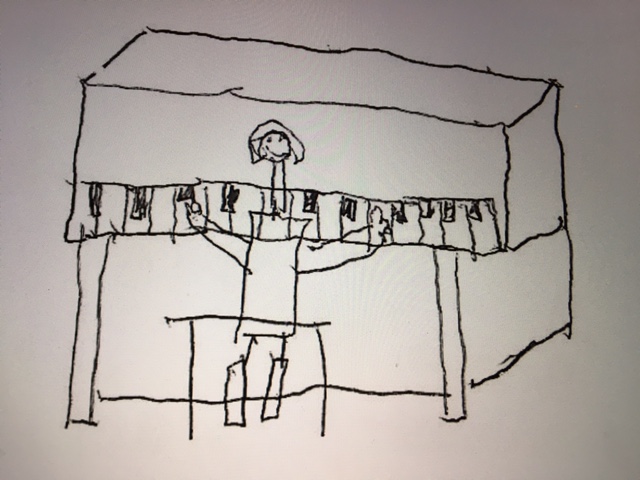
Drawing 1: Carol playing the piano.
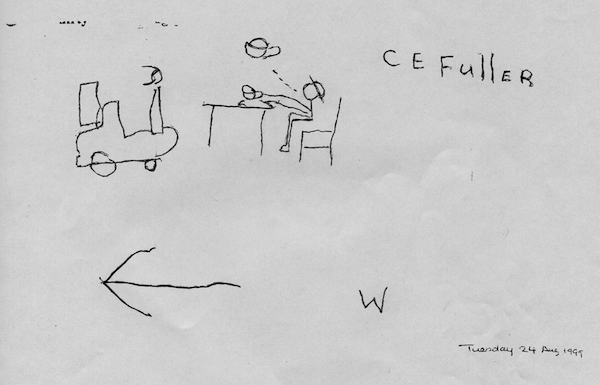
Drawing 2: Clive rode his scooter down to the coffee shop. He is sitting at the table. He has a cup of coffee (also enlarged to make it clear): the arrow points in the direction of the coffee shop. The ‘W’ is the western direction. Clive always liked to sign his name on his drawings.
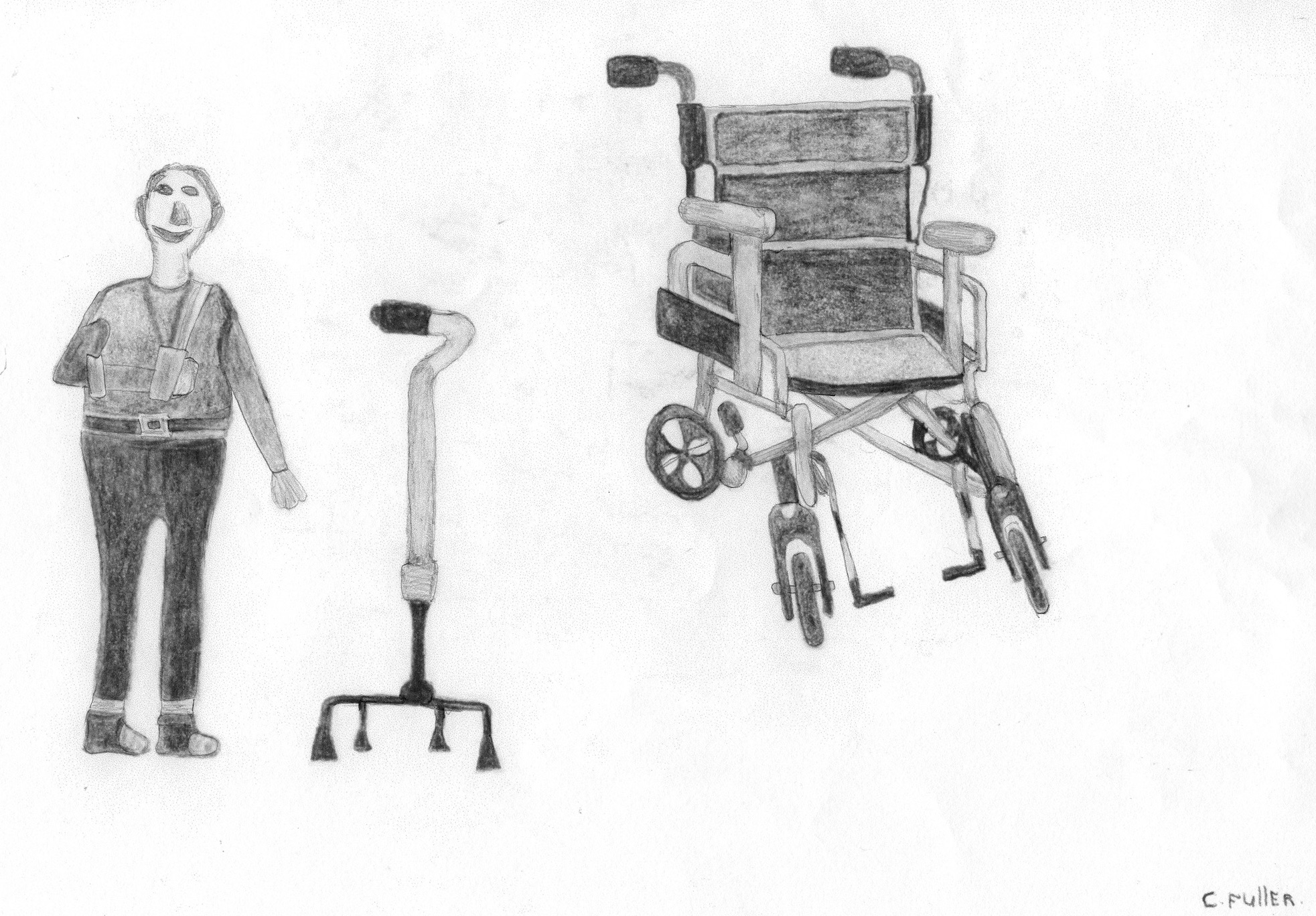
Drawing 3: Clive standing with his arm in a sling. He is standing near his quad. He has a brand-new wheelchair. He is happy, as he is about to embark on an overseas trip to Hong Kong to see his daughter. Clive signed his drawing.
Language can be expressed through many mediums; Clive’s drawings are a fine example of this. As time progressed so did his art of story-telling.
I am now going to bow out of this story and leave you with another form of communication – a poem – a ‘shorthand’ story; a self-descriptive story full of meaning.
THE MAN IN THE GLASS
When you get what you want in your struggle of pelf,
And the world makes you a King for a day;
Then go to the mirror and look at yourself,
And see what that man has to say.
For it isn’t a man’s father, mother or wife,
Whose judgement upon him must pass;
The fellow whose verdict counts most in his life,
Is the man staring back from the glass.
He’s the fellow to please, never mind all the rest,
For he’s with you clear up to the end;
And you’ve passed your most dangerous, difficult test,
If the man in the glass is your friend.
You can fool the whole world down the pathway of years,
and get pats on the back as you pass;
But your final reward will be heartache and tears,
If you’ve cheated the man in the glass.
- Dale Wimbrow

Author: Echoes Of A Closed Door – A Life Lived Following A Stroke