At 40, Jim collapsed with a stroke

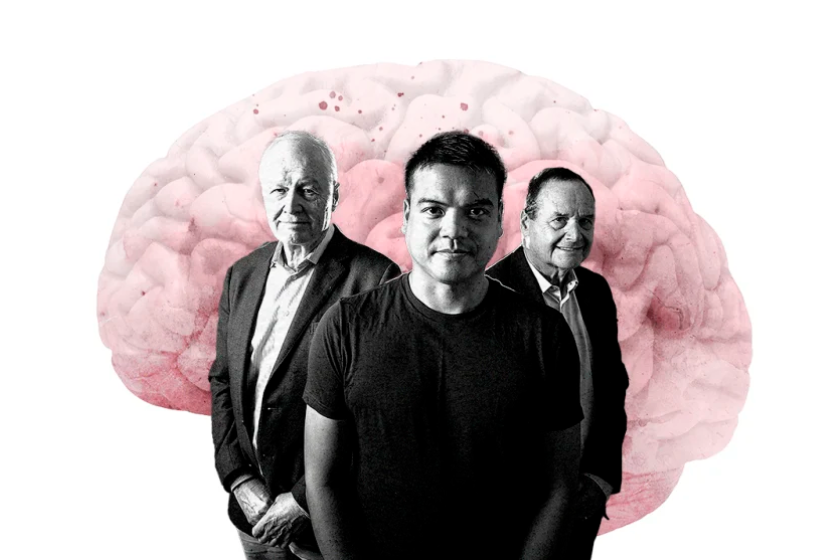
Forty-year-old Jim Khamphouy was warming up at the gym when he suddenly lost all feeling in one side of his body. He clenched his fist but there was no sensation. He tried to walk and fell over. People asked him what was wrong, but his words were incoherent.
“I knew nothing about stroke; I didn’t even know I was having one,” he says. “I just thought, oh my God, this is how people pass away.”
A stroke can be as harmful to our brains as a car crash, yet the damage is inflicted as we sleep or go about our daily life. Once an artery carrying blood to the brain blocks or bursts, it kills cells in our most complex organ faster than any other disease. As the brain loses function, our ability to move, think and feel can steadily shut down.
An estimated 27,400 people in Australia have a stroke for the first time each year. Four in 10 people have another stroke within 10 years. Two-thirds of all strokes are in people 65 or older. But stroke is not just an older person’s disease; nearly 150,000 Australian adults under 65 are living with the impact of having had a stroke. The total number of strokes in 2020 was about 39,500.
In extremely rare cases, a stroke can cause locked-in syndrome – a condition paralysing all voluntary muscles except for a person’s eyes. Often people can avoid severe disability if they receive treatment fast enough. Since 1980, the death rate for strokes in Australia has declined by three-quarters. Still, stroke remains the world’s second-biggest killer after heart attack – strokes killed 8500 people in Australia in 2021 – and it is a leading cause of disability.
Australia’s only mobile stroke unit, introduced in 2017, rushed to Khamphouy that day, treating him in a so-called “golden hour” that gives the best chance of a full recovery. Two days later he walked out of hospital. A decade ago, he might not have survived. The difference in the outcome “were it 10 or 20 years ago, or even before we had the stroke ambulance, is like night and day”, says neurologist Geoffrey Donnan, who first treated him.
So, what is a stroke? How do you know you’re having one? And how fast does treatment need to be?
Stroke survivor Jim Khamphouy with professors Geoffrey Donnan, left, who first treated him, and Stephen Davis, right, who with Donnan set up the mobile stroke unit that diagnosed him.
What causes a stroke?
What doctors call a stroke begins only once the brain is affected, but the problem often starts elsewhere in the body, in the highways that carry blood to the head.
In the most common type of stroke, called ischaemic (from the ancient Greek for stoppage of blood flow), an artery becomes blocked and cuts off blood supply to part of the brain. Starved of oxygen and nutrients, nearly 2 million nerve cells die each minute. (The brain has about 86 billion nerve cells.)
An artery in the brain usually becomes blocked by a clot that starts in the large arteries in the neck, or that comes from the heart, says Royal Melbourne Hospital’s Melbourne Brain Centre director Stephen Davis. For example, a build-up of cholesterol and fatty material can harden or narrow the neck artery. If this plaque becomes inflamed and causes blood clots to form, the clot can break off and travel to the brain.
In a quarter of ischaemic strokes, the clot develops in the heart. People most at risk have an irregular heartbeat – atrial fibrillation – causing a clot to form on their heart wall, which ends up in their brain. “They are usually bigger clots,” says Donnan, who also co-chairs the Australian Stroke Alliance. “And the stroke is usually more severe.”
More severe still is a haemorrhagic stroke (from the Greek for violent bleeding), which is when a vessel in the brain bursts. About 15 per cent of strokes are haemorrhagic. Delicate blood vessels deep in the brain can weaken, usually because of high blood pressure. They are so tiny that doctors have trouble detecting them. If they burst, leaking blood causes an intracerebral haemorrhage.
Advertisement
In other cases a weakness in the wall of an artery forms an aneurysm, appearing like a bubble, which can burst, triggering a subarachnoid haemorrhage, where blood floods onto the surface of the brain. A burst aneurysm causes death in half of cases, while two-thirds of survivors suffer permanent brain damage.
In both types of haemorrhage, Donnan says, pressure builds like a balloon inflating in the skull. “The sheer pressure of it causes the damage,” he says.
Read more on The Sydney Morning Herald
CREDIT: Jackson Graham, The Age.