Return to leisure activities

Return to leisure activities
It is important that everyone allows time to engage in activities that they find enjoyable. This can help enrich your life in a number of ways, and importantly have fun in the process.
You may find yourself unable to continue the leisure activities you enjoy in the same capacity after your stroke. This blog is intended to provide suggestions to help you get started with returning to leisure activities after your stroke and where you can go for more support.
What are leisure activities and how can they benefit me?
Leisure activities can be any task that a person engages in for pleasure, relaxation or emotional satisfaction. Essentially, it’s an activity that a person enjoys doing.
After having a stroke, it is common for people to be aiming for improvement in their function. Your rehabilitation can be tailored specifically to you and the activities you enjoy. Your brain is changeable and learns more from activities which you are enjoying and engaged in.
The list is endless for options of leisure activities. Some examples are:
- Cooking
- Sports
- Games (board games, mini golf, bowling, laser tag)
- Reading
- Playing or listening to music
- Fishing
- Arts/craft/woodworking
- Social interactions (eg. Having coffee with a friend)
- Going to the movies
- Gardening (at home or in community gardens)
- Being out in the community (going for a walk/ride/drive, visiting shopping centers, swimming at the local swimming pool).
Who can help me return to leisure activities?
Your support network can help you return to leisure activities. This might include your family, friends or support workers who may assist with a range of tasks, including motivation to help with transport to your activities. Trying something new is often more enjoyable with a friend so consider asking them to join in. Your allied health team, or health supports may also be able to assist you as well to help you participate. For example, physiotherapists are movement specialists who can help you improve your mobility or use aids to access different environments, improve movement skills, such as being able to turn a page or hit a tennis ball, and help you to minimise risks such as falls or injuries while you’re enjoying leisure pursuits. Physiotherapists may also work as part of a multidisciplinary team with other allied health and health supports to provide optimal care.
What are some challenges and how can I overcome these?
There are a number of challenges that people may face when it comes to participating in leisure activities. It is important to recognise challenges so that strategies can be put in place to ensure that there is adequate balance of leisure and non-leisure activities.
1. Time
Challenge: A busy schedule is often the most challenging and prevalent factor restricting participation in leisure activities.
Strategy: Try to plan in advance and prioritise a leisure activity to discover something you might enjoy.
2. Motivation
Challenge: It is not uncommon for people who have had a stroke not to feel motivated to engage in leisure activities.
Strategy: Communication with your support network may be useful to discuss your motivation, mood changes and fatigue after your stroke and how these are impacting your participation.
3. Access
Challenge: Some people feel they are unable to participate in certain leisure activities due to accessibility for wheelchairs, mobility aids or other environmental barriers.
Strategies: Discuss this with your support network. Points you may raise could be: how you can use funding supports for travel, learning how to use public transport perhaps with your physio, or having a support worker drive you to events. Environmental barriers may also be able to be curbed through means of introducing temporary ramps or by use of matting to level out some surfaces (such as beach matting over sand).
4. Costs
Challenge: Some leisure activities do have costs involved, though it should be stressed that this is not the case for all activities.
Strategies: You may be eligible for the NDIS if you are under 65, or an ACAS assessment if you are over 65. Ask your GP if you are unsure. Some funding bodies such as the NDIS may be able to assist in the financial contribution towards your leisure engagement as this contributes to your overall wellbeing. It should be highlighted here though that many leisure activities are free, or very low cost. This includes, though is certainly not limited to walking in the community with a friend, going for a drive to a beach, cooking and reading.
5. Skill level
Challenges: Some activities may require a certain level of skill or technique to be able to participate in them effectively.
Strategies: Many activities do have options to increase accessibility through use of equipment, support or assistance from others or even some types of technology. For example, weighted knitting needles may allow you to be able to control the impaired coordination of your upper limbs to enable you to knit, or the use of a sit ski may allow you to still enjoy snow skiing with friends. Consider speaking to your allied health team about exercises to improve your skills so this can be something you work on as part of your rehabilitation process.
Organisations that might be helpful for stroke survivors
Disability Sport & Recreation https://www.dsr.org.au/
Access for All Abilities Play https://aaaplay.org.au/
Disability Sports Australia https://www.sports.org.au/
Paralympics Australia https://www.paralympic.org.au/get-involved/
Reclink Australia https://reclink.org/
Community centers, neighborhood houses and local libraries often hold creative groups/classes or provide community gardens:
- Victoria https://www.nhvic.org.au/find-a-neighbourhood-house
- New South Wales https://lcsansw.org.au/Public/Resources/Find-A-Centre.aspx
- Queensland https://www.qld.gov.au/community/your-home-community/groups-in-your-community/neighbourhood-community-centres
- Tasmania https://www.nht.org.au/neighbourhood-houses-tasmania
- South Australia https://sacommunity.org/az/13419-Community_Centres
- Northern Territory https://www.darwin.nt.gov.au/community/community-facilities/community-centres
- Western Australia https://perth.wa.gov.au/en/live-and-work/community-services-and-facilities/facilities-list
Support groups https://enableme.org.au/community/support-groups
Podcasts: Listenable, Disability done different - candid conversations, The Joe Show - connecting all abilities
Respite day trips, travel https://www.leisureoptions.com.au; http://247careozzietrips.com.au/index.html
Men’s shed https://mensshed.org/
Crafting/quilting groups (through local governments/community centers) eg: http://knoxlearningalliance.org.au/category/arts-and-crafts/
U3A Australia https://u3aaa.org/
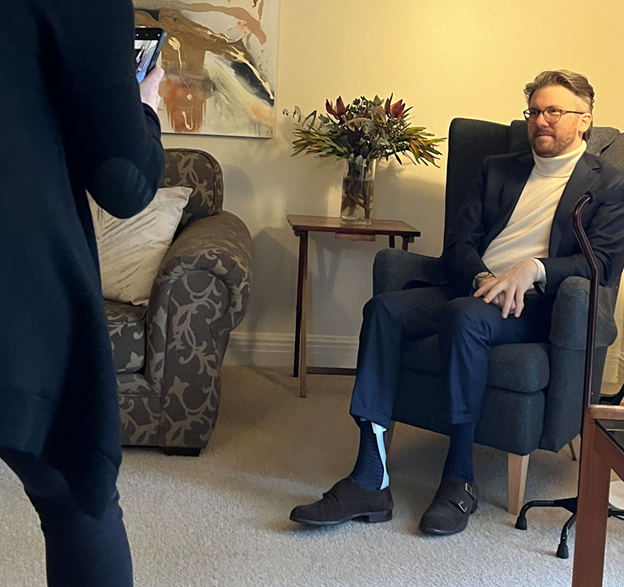
Andrew – showing off his fashion and creating content for his online blog.
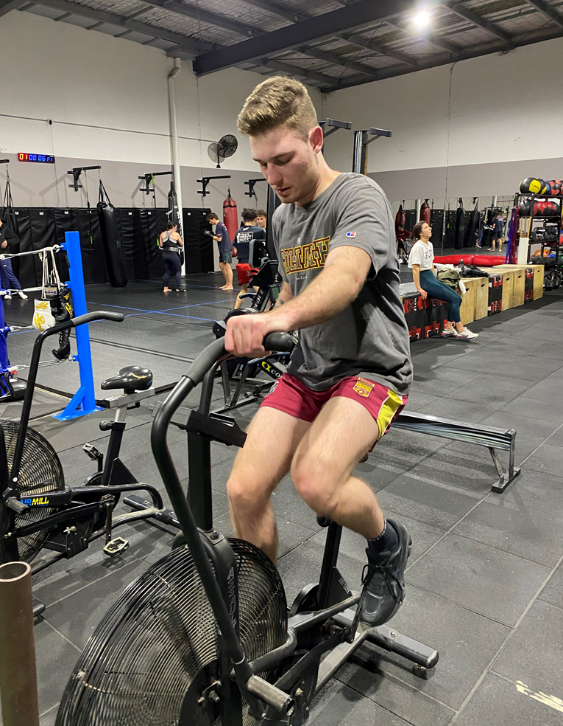
Sam – Working out in a group fitness session at his local gym.
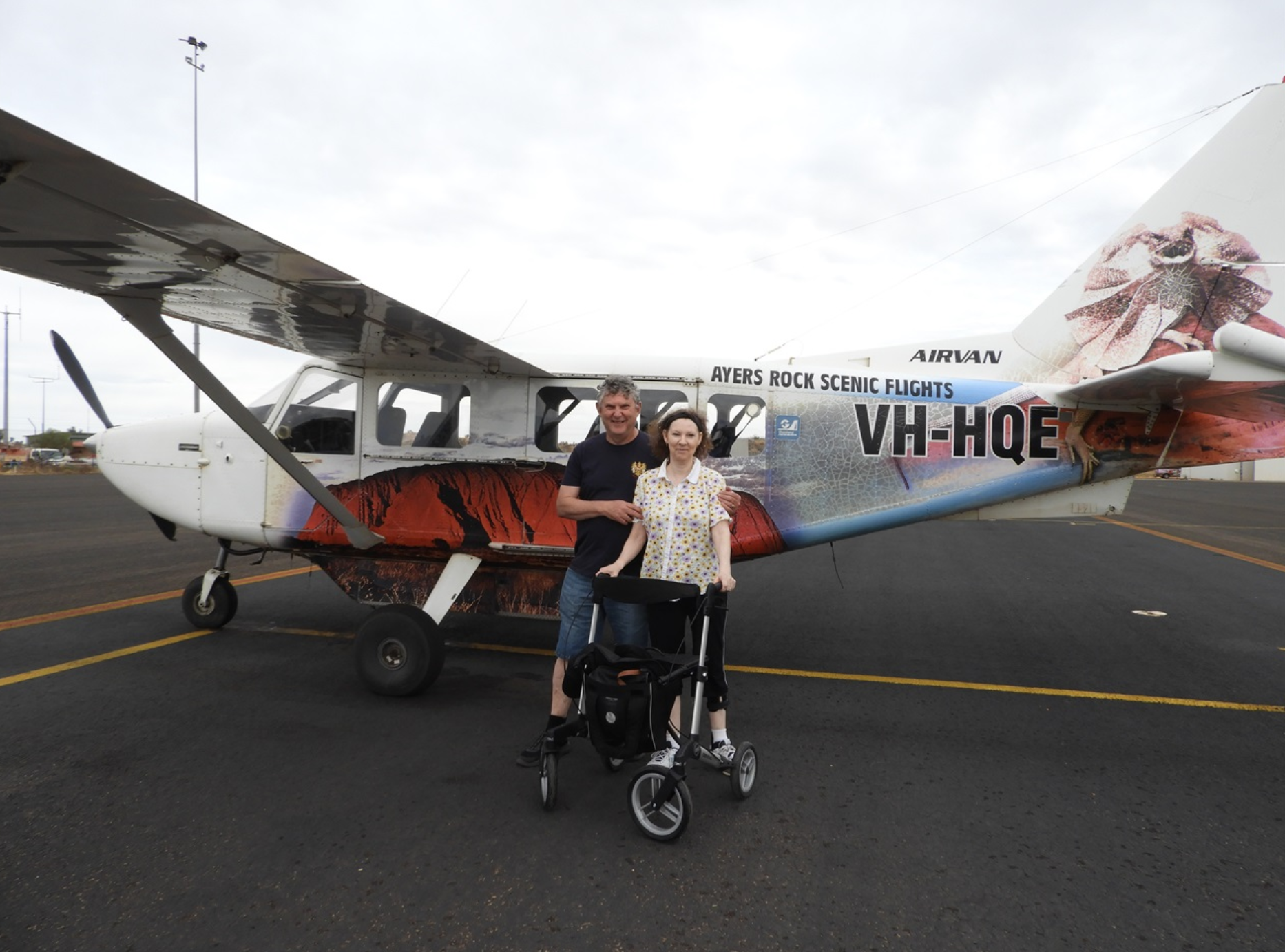
Catherine – About to climb aboard at scenic flight around Uluru.
Written by: Amy Jordan APAM and Jill Kentish APAM
References:
Dorstyn, D., Roberts, R., Kneebone, I., Kennedy, P., & Lieu, C. (2014). Systematic Review of Leisure Therapy and Its Effectiveness in Managing Functional Outcomes in Stroke Rehabilitation. Topics in Stroke Rehabilitation, 21(1), 40–51. https://doi.org/10.1310/tsr2101-40
https://www-sciencedirect-com.ezproxy.flinders.edu.au/science/article/pii/S0891061820300910
Simon S. Kjeldsen, Liv Brodal, Iris Brunner. (2022) Activity and rest in patients with severe acquired brain injury: an observational study. Disability and Rehabilitation 44:12, pages 2744-2751.