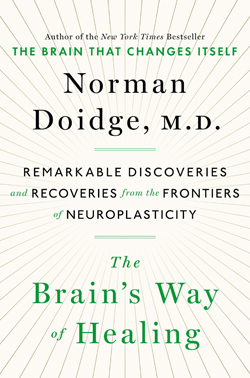
'The Brain's Way of Healing' by Dr. Norman Doidge

Kelcie
Kelcieon Tuesday, April 7 2015
7 Comments

I've just started reading the second book by Dr. Norman Doidge who also wrote the very popular 'The Brain That Changes Itself'. I have to say; it's a great read so far!

In his new book Dr. Doidge talks about the phenomenon of neuroplasticity and shares incredible stories of people who have used neuroscience to help overcome recovery obstacles & reduce the symptomatic effects of stroke and neurodegenerative conditions like Parkinson's Disease. It is very easy to understand and provides hope and inspiration to those personally experiencing the journey of recovery. Recommended!
7 Responses
Hey Kelcie, Cheers for the heads up that he has a new book. Reading TBTCI was a turning point in my recovery and it lead me to pursue further therapy in a research setting. I find it somewhat perplexing, that many doctors and allied health professionals still talk about the window for recovery, whether that window be 3 months, 6 months or 12 months or worse still give pessimistic prognosis for recovery. My experience is that the brain is plastic forever and with access to quality ongoing therapy survivors can continue to pursue recovery goals if that's what they wish to do.How is his second book different to his first?
Hi Karen, So great to hear you were inspired to take you recovery into your own hands after reading TBTCI (love your acronym!). I've only just started reading TBWOH and sadly haven't picked it up much this week but compared to his first book I would say that this one discusses the science of neuroplasticity more and share insights into different theories or approaches to healing. Much like his first book it is an easy and elegant read. He continues to use patient stories to bring the science alive which is wonderful. He also shares examples of non-invasive & holistic therapies (involving different energies) that can be harnessed to change the brain's electrical activity and literally 'awaken' parts which are under-responsive or dormant. For me it is also interesting to see a neuroscientist talk about the influence the mind has on the brain and draw on theories long used in Eastern practice. It's helping me expand my own thinking!
I really enjoyed the 1st book, even got the DVD. Didn't know about a 2nd, it's true about 'our' practitioners not updating/learning more.
I haven't begun on his new book. By the way,Norman Doidge is a philosopher, researcher and author, not a neuroscientist himself. I lost patience with his "The Brain that Changes itself" mainly because he's made trips to Australia but never talked about clinics here that we can avail ourselves of, and many of the stroke success stories I read of were of wealthy people in America going to clinics in America. I even rang the ABC to try to catch him before he moved on to ask him about comparable places for us to go to here without the expense of tripping to America. It seemed to me that his trips were a quick money making fly in fly out venture to sell his books Perhaps I'll return to his book to dip into the philosophical section next. But time is always running out for me.

Like Karen I also had negative responses from health professionals when it comes to recovery. I was initially told to do nothing for six months and later advised that my brain would not change after twelve months and in one case I was told I would not make any progress after three months. Fortunately I am an optimistic person and sought my own way forward . If it was not for the book 'How I Rescued My Brain' by David Roland I would not be the making progress I am today. David Roland is an Australian author with a PhD in clinical psychology and his book is a moving memoir of his own experience in the  stroke recovery process. This book gave me a way forward in devising my own program for recovery and I will always be grateful for having found this book. Both books by Norman Doidge were enlightening.  

Hi Karen, have you seen this talk from David Roland? 

Loading reply form...