Vertigo or not Vertigo

Roson Sunday, November 19 2017
11 Comments
Hi Ros,
I’m really sorry to hear that you were misdiagnosed and it took some time to get a proper diagnosis for your stroke.
You are absolutely right – vertigo is a symptom that could be a result of many different conditions. It’s crucial that a cause for the vertigo is established.
If you’d like to speak with one of our health professionals on StrokeLine please don’t hesitate to contact us on 1800 787 653 (Mon-Fri 9am-5pm AEST).
Best wishes,
Katherine (StrokeLine)
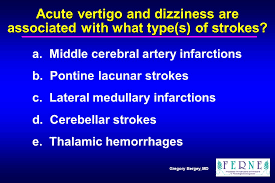
It appears that many people who suffer symptoms of vertigo while actually having had a stroke are being misdiagnosed. When I was finally moved out of the ER in my local hospital and down to the major hospital in my area, the neurologist given my case decided to treat me as if I had a stroke before any results came through. As he said, the treatment could always be stopped if I had not had a stroke but it would be best for me to begin the treatment just in case. All the doctors, nurses, and the neurologist were quite surprised when my MRI showed I had indeed suffered not one but two strokes (one in the left cerebellum and a small one in the left parietal lobe) as I didn't fit their idea of someone who would suffer a stroke. All the research I have found online states that cerebellar strokes are rare; accounting for only 3% of all strokes. I now wonder if that percentage is higher. If misdiagnosis is common then there is a real possibility that cerebellar strokes are not as rare as research suggests.
Hi Ros, I found your article particularly interesting as I have developed similar symptoms over the last 10 - 12 weeks but had my stroke 9 months ago. The stroke occurred in the brain stem and was classified as ischemic lacunar. Until I read your article I have never heard the word pontine. The sensation of vertigo impacts badly on my balance but I never fainted. Would appreciate your comments and advice. Regards kingge (aka Bronwen)
In regards to advice, I suggest you contact the Stroke Foundation. They will be able to help you there. If it were me, I would be asking my specialist what he/she thinks. I would hope that they suggest an MRI to see what is going on, as this is the only way to view damage to the cerebellum. It has only been 10 weeks since my Cerebellar and Parietal Lobe Stroke and my balance is slowly improving day-by-day; unless I do too much - which I often do! I have developed a method of walking around the house that seems to keep me from straying off my chosen path, and when I am out of the house I use a walking stick to help prod me back on line! I tend to just push through my fatigue as I know it will be there whether I rest or not. Finally, please speak to your specialist and follow up on your concerns.
Thank you Ros I can reiterate your post.
Over 2 years ago I experienced vertigo and was extremely unwell. The doctor, after testing me for stroke, advised me that I had vertigo and provided me with medication and sent me back to bed to recover. After going back to work (a couple of weeks later) still not feeling 100%, I again experienced vertigo and went back to bed on my medication provided by the doctor. After a day in bed, feeling very unwell, I finally went to the hospital under my own steam, who advised me that I have had experience a number of cerebellar strokes over the previous month, with vertigo as a symptom.
They advised me, unknown to me, that I had a blood clotting factor and a hole in the heart (patent foramen ovale), both increasing my risk of stroke. My PFO has been closed through an implant into my heart (similar to a stent) and I am on blood thinners, reducing my risk of stroke.
I find you post very interesting and concerning, noting that a number of my friends have also experience vertigo, the questions is whether they have been misdiagnosed.
Regards
Adam
Hi all Merry Christmas.
Thank you Ros I can reiterate your post.
Over 2 years ago I experienced vertigo and was extremely unwell. The doctor, after testing me for stroke, advised me that I had vertigo and provided me with medication and sent me back to bed to recover. After going back to work (a couple of weeks later) still not feeling 100%, I again experienced vertigo and went back to bed on my medication provided by the doctor. After a day in bed, feeling very unwell, I finally went to the hospital under my own steam, who advised me that I have had experience a number of cerebellar strokes over the previous month, with vertigo as a symptom.
They advised me, unknown to me, that I had a blood clotting factor and a hole in the heart (patent foramen ovale), both increasing my risk of stroke. My PFO has been closed through an implant into my heart (similar to a stent) and I am on blood thinners, reducing my risk of stroke.
I find you post very interesting and concerning, noting that a number of my friends have also experience vertigo, the questions is whether they have been misdiagnosed.
Regards
Adam
Hi Adam; Merry Christmas to all as well! I agree, it is of concern that cerebellar strokes are often misdiagnosed as vertigo. What is of even greater concern is one of the 'fixes' for vertigo involves manipulating the suffer's neck - gently, but manipulation nonetheless. Many articles regarding cerebellar strokes state that manipulation of the neck can result in death! This is due to the possible build-up of fluid as well as the swelling of the cerebellum due to the stroke. I sincerely hope that there is more research into this type of stroke as well as the blanket diagnosis of vertigo when someone presents with a loss of balance.
Before you can post or reply in these forums, please join our online community.