Hello Lee
Thank you for reaching out on EnableMe and thank you for sharing what you are going through. This change as an impact of stroke must be difficult for both you and your husband, so it is great that you are reaching out for support. I am sure there will be others who will be able to comment and share their experiences to this question.
It sounds like what your husband is noticing may not just be about your communication, but perhaps about personality or mood changes. Have you noticed any other issues such as getting frustrated more easily or becoming angry without realising?
The Australian Brain Injury Organisation Synapse explains that a brain injury can damage areas of the brain involved in the control and regulation of emotions, particularly the frontal lobe and limbic system. Other effects of a brain injury can lead to irritability, agitation, lowered tolerance and impulsivity, which also increases the likelihood of angry outbursts. If you would like to know more, you can read about these issues at Anger - Synapse
Changes in personality can be common after stroke, and they can be the most difficult changes to understand and get used to. After a stroke, existing personality traits can become exaggerated and sometimes, people behave in ways that are not like them at all, and they may not realise how they appear to others. This can have a profound impact on stroke survivors and their relationships, so it is great you have reached out.
A lack of self-awareness is a common outcome for people who sustain brain injuries, which becomes difficult for a person to assess their own ability and limitation. It is possible for a person to increase their level of self-awareness, with some techniques highlighted here: Impaired awareness - Synapse. We have other resources we can share with you if you would like to reach out to us over the phone or via email (see below for contact details).
As your husband has noticed changes in how you are interacting with other, or yourself, it might be helpful to ask your GP about a referral to a psychologist as they can work with you on behavioural management strategies that may help. It can also be helpful to talk to trusted family members (like your husband) and friends, so that they understand what is happening and can provide support. Your communication coming across as aggressive and irritated is not a choice, but the impact of your stroke.
It would be good to talk with you directly to discuss in more detail what is happening for you. Do give us a call here at StrokeLine on Ph: 1800 787 653 or email us at strokeline@strokefoundation.org.au. We are available Monday to Friday 9am to 5pm.
Kind regards
Siobhan and Karina (StrokeLine)

Hi Lee,
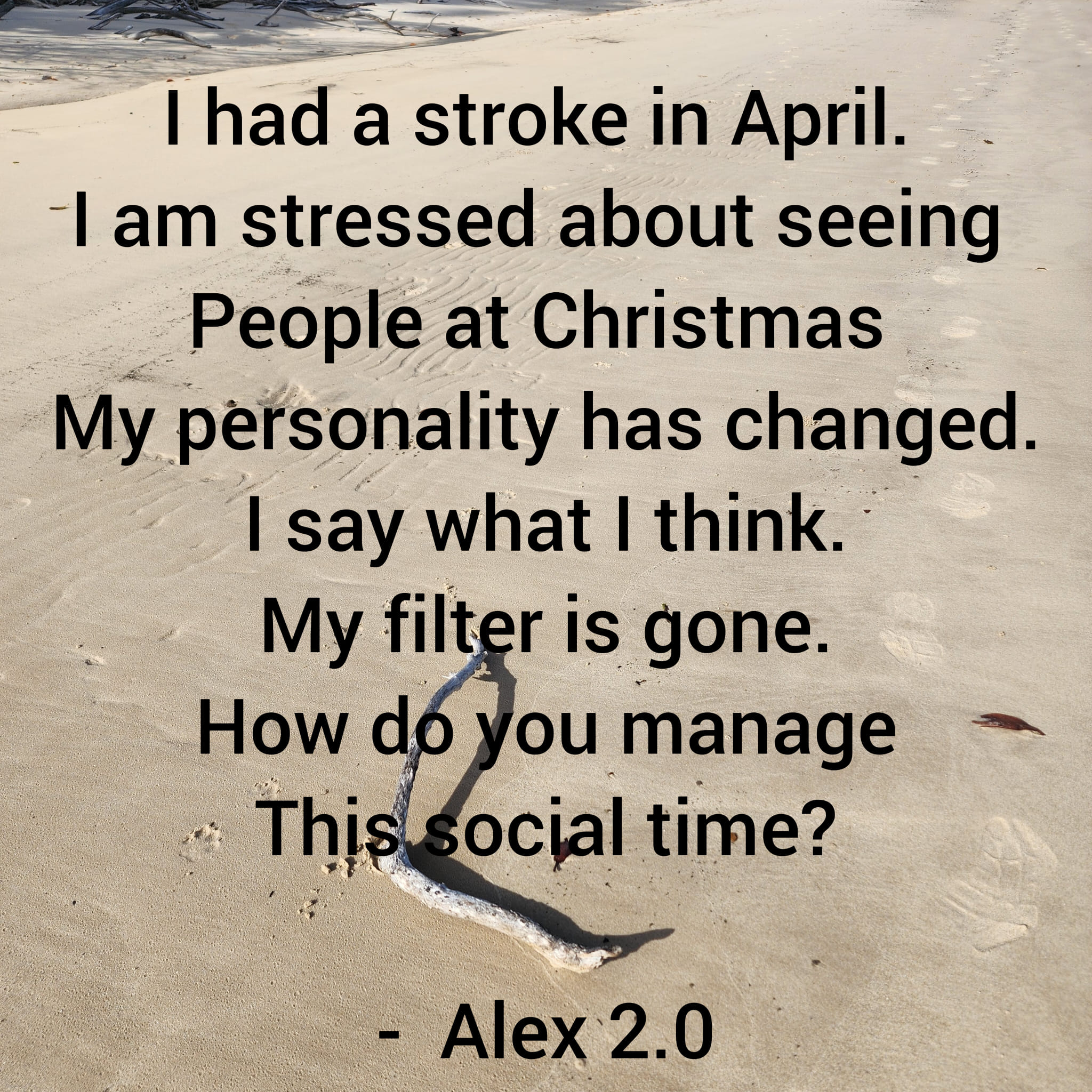
Alex asked a similar question. I thought that you may find the answers from the Facebook community helpful.
Jo Kyte
Oh Alex I’m so with you on this, it’s so hard to adjust to the new you, especially when you can still remember the old you and personality, everyone forgets that a brain injury is an invisible one, I wish sometimes you could wear it on your arm so people can see. I feel the best way to deal with this is be honest with everyone and just tell them you may need to walk away or not come or just be there in person but have some quiet time. I fully understand how stressed you feel. Having no filter is also such hard work, I often say things I would never have ever said to people before and often in a way I don’t mean.
Tom Hilton
I have no patience outside of my networks for things iI once did. My advice is keep your catch ups to those who you know well and love/like you for who you are. Whilst you may have changed a little your still the same person you were. Try and surround your self with those most dearest. They will understand.
Priscilla Pluess
When it comes to this and having long term issues see it as that those who care (what others think) don't matter. And those that matter (that love you no matter what) don't care (what others think)
Vicki McGregor
My hubby had a stroke almost 2 years ago - 23 December. His filter was definitely gone but over time he has gotten so much better at controlling that. He still asks me though if he said anything wrong. We are very social and we started with this almost straight away. I almost had to have a roster for people to come visit as we have so many amazing people in our lives who just wanted to see he was ok and genuinely cared about him. Just take things at your own pace and as others have said those that truly love and care for you will accept things the way they are now. It is hard being the onlookers too and they don’t understand what you might be thinking inside your head. If there is no physical disability (in my husbands case), it’s even harder for people to know there is a difference in the way you think and feel. It’s such a hard journey some days but with the support of the ones closest to you, you will be ok. I would have a “look” or I would give him a rub on the arm if I thought my husbands filter was truly coming down. Sometimes I’d just guide the conversation in another direction. All the best and I do hope you can enjoy some time with family and friends. It’s nice to have them around too. all the best.
Jennifer A. Houghton
Take timeout when you need to. I had a stroke a month before last Christmas. Because I was unable to drive my son picked me up and took me to his family for Christmas. I felt trapped! I'm in a busy household and can't escape. Christmas day was hell. I got overwhelmed so many times. Three days after Christmas I put myself on a bus and went home. I still struggle with my personality changes.
Hi Lee, I had a stroke in August 2022 and it turns out I have also had a stroke before that time. Since August 2022, I do feel I have less patience. More fatigued and perhaps ore grumpy. I am not aggressive as such or violent, but I do realise that I snap more. Feels like the short temper when feeling extremely tired.
I've been told this is seen in stroke victims. I try to correct my response when I detect it.